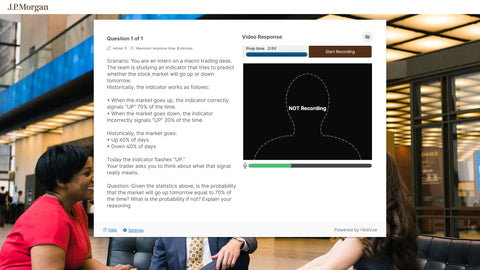
The 2027 Commercial and Investment Bank Markets Summer Analyst Program at J.P. Morgan, the Hong Kong role, opens with a recorded HireVue before a human joins the process, and it screens out a lot of people early. The ones who clear it usually practiced the real questions instead of improvising into a webcam. This interview is a single question, Question 1 of 1, with roughly three minutes of prep and two minutes to speak. The wording sounds like desk chatter, but underneath it is a conditional probability problem, and the whole point is to see whether you can spot that.
Here is the exact wording:
Scenario: You are an intern on a macro trading desk. The team is studying an indicator that tries to predict whether the stock market will go up or down tomorrow.
Historically, the indicator works as follows:
• When the market goes up, the indicator correctly signals "UP" 70% of the time.
• When the market goes down, the indicator incorrectly signals "UP" 20% of the time.
Historically, the market goes:
• Up 60% of days
• Down 40% of days
Today the indicator flashes "UP."
Your trader asks you to think about what that signal really means.
Question: Given the statistics above, is the probability that the market will go up tomorrow equal to 70% of the time? What is the probability if not? Explain your reasoning
The 70 percent is bait. It reads like the answer because it matches the signal you just saw. But 70 percent is the chance the indicator shouts "UP" on a day the market actually rises. The question wants the opposite direction: the market just got an "UP," so how likely is it to rise. Confuse the two and you fail the point of the exercise.
Where candidates go wrong
- Repeating 70 percent. Lifting the indicator's accuracy off the page and calling it the probability is exactly the answer the question is designed to catch.
- Reversing the conditional. The chance of an "UP" signal given a rising market is not the chance of a rising market given an "UP" signal. Swapping them is the textbook base rate error.
- Dropping the base rates. The 60 and 40 are not decoration. Leave them out and Bayes has nothing to update from.
- Skipping the false positives. The indicator also fires "UP" on 20 percent of down days. Miss that and your denominator is incomplete.
- Answering "more than 70" with no math. Feeling the direction is not the same as producing 84 percent. Without the working it sounds like a hunch.
- Talking without landing a number. A trader wants the figure first and the logic second. Rambling for two minutes with no clean posterior loses the room.
What a strong answer does
A strong answer opens by saying it is not 70 percent, then builds the calculation cleanly. Start with the prior: 60 percent of days rise, 40 percent fall. Add the signal behaviour: 70 percent of rising days trigger "UP," 20 percent of falling days trigger "UP" too. There are two roads to an "UP" signal. The rising road carries 0.60 times 0.70, which is 0.42. The falling road carries 0.40 times 0.20, which is 0.08. Add them and an "UP" signal appears on 0.50 of all days.
Now take the share of that half that came from real up days: 0.42 divided by 0.50 is 0.84. The market rises 84 percent of the time after this signal. Finish on the read a trader wants: the indicator is genuinely useful, it moves your estimate from the 60 percent base rate up to 84 percent, but the 70 percent number was answering a different question all along. It measured the indicator, not the market. Saying that difference plainly is what makes the answer land.
Get the ones for your role
This is the whole interview, one question, and it favors people who have worked through conditional probability in advance rather than on the timer. OfferTutoring keeps the full J.P. Morgan Markets question set if you want the real prompts for the Sales and Trading roles in front of you before you record.