
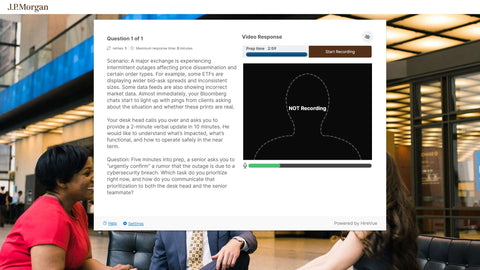
The 2027 Commercial and Investment Bank Markets Summer Analyst Program at J.P. Morgan, the Hong Kong role, opens with a recorded HireVue before a human joins the process, and it cuts a lot of people early. The ones who clear it usually practiced the real questions instead of improvising into a webcam. This interview is a single question, Question 1 of 1, and it is generous with prep, close to three minutes, then two minutes to answer. That is deliberate. A prompt that needs that much thinking time is not a warm up behavioral, it is a markets judgment scenario built to watch you make a call on a live desk.
Here is the exact wording:
Scenario: A major exchange is experiencing intermittent outages affecting price dissemination and certain order types. For example, some ETFs are displaying wider bid-ask spreads and inconsistent sizes. Some data feeds are also showing incorrect market data. Almost immediately, your Bloomberg chats start to light up with pings from clients asking about the situation and whether these prints are real.
Your desk head calls you over and asks you to provide a 2-minute verbal update in 10 minutes. He would like to understand what's impacted, what's functional, and how to operate safely in the near term.
Question: Five minutes into prep, a senior asks you to "urgently confirm" a rumor that the outage is due to a cybersecurity breach. Which task do you prioritize right now, and how do you communicate that prioritization to both the desk head and the senior teammate?
There are two jobs pulling at you and only one is real work. The desk head's update is verified, time-boxed, and top-authority. The rumor is unconfirmed and, if you repeat it wrong, dangerous. The interview is checking whether you can rank those correctly and say the ranking out loud.
Where candidates go wrong
- Running after the breach rumor. Confirming an unverified cyber claim is not your job, and passing it on as fact spreads unconfirmed information that can move prices and rattle clients.
- Letting the desk head's update slip. It came from the most senior person in the room with a hard deadline. Abandoning it for a rumor is the wrong trade.
- Doing both at half speed. With ten minutes on the clock, dividing yourself leaves the update thin and the rumor still unconfirmed. Neither lands.
- Never naming a priority. If you do not tell both people what comes first and why, they are left guessing while the outage runs.
- Guessing at the cause. Speculating on camera about whether it is a breach is the loose talk that gets people into trouble mid outage. You have no data, so you do not guess.
- Leaving one person in the dark. Answering the desk head and ignoring the senior, or the reverse, reads as weak communication when it matters most.
What a strong answer does
A strong answer leads with the ranking in a single line: the desk head's two-minute update is first, because it is verified, time-boxed, and came from the top of the desk. Then it shows what that update contains. What is impacted: the ETFs quoting wider bid-ask spreads with unreliable sizes, the order types that are down, the feeds pushing bad market data. What is still working. And how to trade safely in the near term: widen caution on the affected names, verify prints before you act on them, use limit orders instead of market orders, and check a price against a second data source before quoting it to a client.
Then it deals with the rumor correctly, which means confirming nothing. You do not tell the senior or anyone else that it is a breach, because you cannot verify it and a wrong claim like that is harmful. You tell the senior directly that you will not confirm an unverified rumor, that you are routing it to the right owner, technology, security, or exchange communications, and that any confirmed fact will go straight into the update. Finally you make the prioritization explicit to both: the desk head hears that the update is on track for the deadline, the senior hears where the rumor sits and who now owns it. Close on the real lesson, that this is a test of verified against unverified, and of keeping clients from acting on information that is not real.
Get the ones for your role
This is the whole interview, one question, and it favors people who have worked through desk scenarios in advance rather than on the timer. OfferTutoring keeps the full J.P. Morgan Markets question set if you want the real prompts for the Sales and Trading roles in front of you before you record.