The 2027 Commercial and Investment Bank Markets Summer Analyst Program at J.P. Morgan, the Hong Kong Research role, opens with a recorded HireVue before a human joins the process, and it cuts a lot of people early. The ones who clear it usually practiced the real questions instead of improvising into a webcam. This interview is a single question, Question 1 of 1, with roughly three minutes of prep and two minutes to speak. It drops you into a live crisis and asks for a two minute update, so the shape of your answer is being graded as much as the content: a real desk update has structure, and rambling gives you away.
Here is the exact wording:
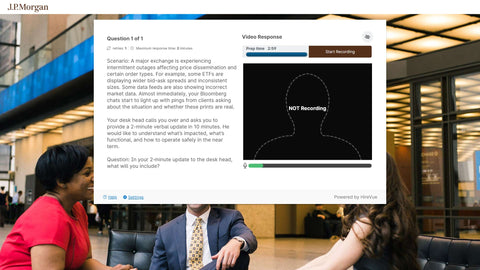
Scenario: A major exchange is experiencing intermittent outages affecting price dissemination and certain order types. For example, some ETFs are displaying wider bid–ask spreads and inconsistent sizes. Some data feeds are also showing incorrect market data. Almost immediately, your Bloomberg chats start to light up with pings from clients asking about the situation and whether these prints are real.
Your desk head calls you over and asks you to provide a 2-minute verbal update in 10 minutes. He would like to understand what's impacted, what's functional, and how to operate safely in the near term.
Question: In your 2-minute update to the desk head, what will you include?
Most people fail this by pouring out details with no order, guessing at the cause, or reassuring everyone it will pass soon. A desk head does not want a data dump or a prediction. He wants three clean things: what is broken, what still works, and how to trade safely until it clears. If your answer is built around those three, you already sound like someone who has stood on a desk during a bad print.
Where candidates go wrong
- Dumping unsorted facts. Reciting every observation with no structure eats the two minutes and hides the message. The desk head cannot trade on a list.
- Guessing the cause. Theorizing about why the exchange failed is unverified and not the point. Report the observable, not a hypothesis.
- Trusting the bad prints. The feed is showing wrong prices. Quoting or hedging off them is precisely how a desk bleeds during an outage.
- Skipping the clients. The chats are already blowing up. An update with no line for sales and clients ignores a live risk.
- No recommendation. He asked how to operate safely. Facts with no proposed stance dump the whole decision back on him.
- Promising a fix time. Saying it will be back in ten minutes is a guess you cannot honor. Give what you know and what you are watching.
What a strong answer does
A strong answer follows the desk head's own three headings: impacted, functional, safe. Impacted: the exchange is intermittently down, price dissemination is unreliable, certain order types are affected, some ETFs show wider spreads and inconsistent sizes, and some feeds are printing wrong prices that cannot be trusted. Functional: the products, venues, and feeds that still look clean, whether you can cross check a price against a second source or the underlying basket, and which order types remain safe. Drawing that line clearly is what lets the desk keep working where it is confident and stand down where it is not.
Then the part he actually cares about, how to operate safely for now. Recommend widening or pulling quotes in the affected names until prices are verified, trading smaller and not chasing suspicious prints, validating every level against a second source before acting, and handling the impaired order types with care. Cover the clients: give sales one consistent message, tell them we see the exchange issues and that some prints may be unreliable, and do not confirm levels you cannot verify. End with what you are monitoring and a commitment to flag the moment things normalize. The point to land is that during an outage you are not there to forecast the repair, you are there to protect the book: sort the real prices from the broken ones, trade only where the data holds, and keep the client message calm and uniform. A composed, structured brief like that is exactly what a Markets desk head is listening for.
Get the ones for your role
This is the whole interview, one question, and it favors people who can deliver a calm, ordered update under pressure rather than people who narrate whatever they notice. OfferTutoring keeps the full J.P. Morgan Markets question set if you want the real prompts for the Sales and Trading roles in front of you before you record.