
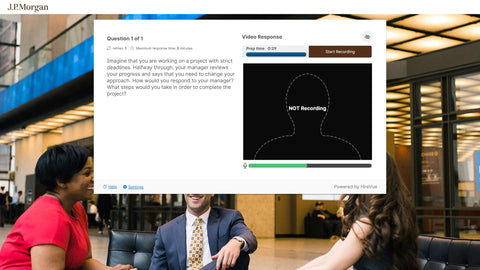
The 2027 Commercial and Investment Bank Markets Summer Analyst Program at J.P. Morgan, the Hong Kong Research role, opens with a recorded HireVue before a human joins the process, and it cuts a lot of people early. The ones who clear it usually practiced the real questions instead of improvising into a webcam. This interview is one question, Question 1 of 1, with about thirty seconds of prep and up to two minutes to speak. It is a behavioral prompt, and underneath it is a test of how you handle being redirected when the clock is running, which is the everyday reality of a trading floor.
Here is the exact wording:
Imagine that you are working on a project with strict deadlines. Halfway through, your manager reviews your progress and says that you need to change your approach. How would you respond to your manager? What steps would you take in order to complete the project?
The mistake most people make is hearing the feedback as criticism and getting defensive, or folding instantly with no questions. Neither works. Your manager is steering, not scolding, and the answer they are listening for shows you can take the note quickly, learn the reason behind it, and rebuild the plan without blowing the deadline.
Where candidates go wrong
- Defending your first draft. Fighting for the work you already did puts pride ahead of the result. The deadline does not reward who was right.
- Agreeing with no understanding. A fast yes with no questions risks repeating the same error in a new shape, because you never learned what was wrong.
- Sounding deflated. Reading as discouraged is the reaction a desk cannot use. Treat the note as information, not a judgment on you.
- Ignoring the clock. The deadline is still strict in the prompt. Change the approach but say nothing about timing and you have answered half the question.
- Offering no concrete steps. The prompt asks for the steps you would take. Staying positive is a mood, not a plan.
- Scrapping everything. Tossing the whole first half is wasteful. Usually parts carry over, and recognizing that shows judgment.
What a strong answer does
A strong answer leads with posture and then moves to method. Start by taking the feedback well and getting specific: thank the manager and ask what exactly is not working and what the new approach needs to deliver, so you fix the real issue instead of guessing at it. Next, gauge the timeline hit: figure out which of the current work still holds, which has to be redone, and whether the deadline is still realistic as things stand. Then re plan aloud: reprioritize toward the pieces that matter most, lay out a revised order of work, and if the switch truly endangers the deadline, raise it early with options, such as delivering a focused core on time and following with the rest, rather than going quiet and missing it.
Then keep it collaborative and, if you can, ground it in a real moment. You check the new direction with the manager before committing to it and you keep them posted as you go, so nothing surprises them at the deadline. A short example seals it: a time someone sent you back to redo part of a task midway, you asked what they were really after, kept what still fit, and delivered a better version on time. End on the idea that pivoting on good feedback is not a failure, it is how the output improves, and the strong analyst does it calmly and still hits the date. That composure is what a Markets team wants, because the market rewrites your plan constantly and they need people who adjust without losing the thread.
Get the ones for your role
This is the whole interview, one question, and with thirty seconds of prep it favors people who have already worked out how they take feedback rather than people winging a pleasant answer. OfferTutoring keeps the full J.P. Morgan Markets question set if you want the real prompts for the Sales and Trading roles in front of you before you record.