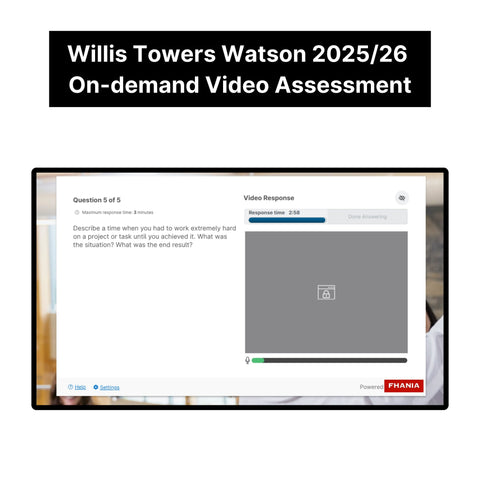
WTW Interview Questions 2027: Tell Me About a Time You Struggled to Reach a Goal
For this Willis Towers Watson interview question, weight STAR toward your response: the ambitious goal and what blocked you, how you diagnosed the blockage and adapted strategy (not just pushed harder), and the honest outcome. Assessors want resilience with method — perseverance, not stubbornness.
Willis Towers Watson Interview Questions: What the Struggle Question Assesses
This question is commonly reported by candidates in WTW's assessments because it separates perseverance from stubbornness — a crucial distinction in professional work, where grinding on a failing approach wastes client time. Interviewers are testing whether you can diagnose why you're stuck, adapt your strategy, ask for help when needed, and sustain effort intelligently. They also watch for honesty: everyone struggles, and candidates who pretend otherwise lose credibility.
Willis Towers Watson Interview Questions: How to Answer
Structure your STAR around the adaptation, not just the effort:
- Situation. The goal, why it mattered, and why it was genuinely hard — set real stakes.
- Task. Your responsibility and what success looked like.
- Action — the struggle and the response. Describe hitting the wall honestly, then show your method: (1) diagnosed the root cause rather than just pushing harder; (2) changed strategy — new approach, new resources, new timeline; (3) sought help or feedback where useful; (4) persisted with the revised plan. The pivot from brute force to smart adaptation is what gets scored.
- Outcome. The honest result — full success, partial success, or a well-managed miss — plus what the struggle taught you about tackling hard goals.
Example line: "Training for my first half-marathon, I plateaued badly at week six with shin pain. Instead of pushing through, I saw a physio, rebuilt my plan around lower mileage with cross-training, and finished the race — slower than my original target, but healthy. It taught me that struggling is data: the plateau was telling me my plan was wrong, not that I was weak."
Common Mistakes
- Struggle without strategy. "I just kept going" is endurance, not judgment — show the diagnosis and adaptation.
- Too-easy goals. If the goal wasn't genuinely hard, the story demonstrates nothing.
- Hiding the outcome. Be honest about partial success or failure; the response matters more than the result.
Keep Reading
- jp morgan tell me about yourself hirevue
- Goldman Sachs HackerRank Test 2027: Format & How to Prepare
- Goldman Sachs HireVue Questions 2027: Full List & How to Answer
FAQ
Should I pick an academic, professional, or personal goal? Whichever shows the clearest struggle-to-adaptation arc with real stakes.
What if I ultimately failed? A well-analyzed failure with genuine learning scores strongly — don't force a happy ending.
How do I show resilience without sounding stubborn? Emphasize the moments you changed course based on evidence — that's resilience with judgment.
Can the goal be team-based? Yes, but keep your personal actions and decisions clearly visible.
Preparing for Willis Towers Watson's interview? Our 2027 Willis Towers Watson WTW On-demand Video Assessment Exact Questions and Answers has practice questions and answers — $79 one-time, instant download.