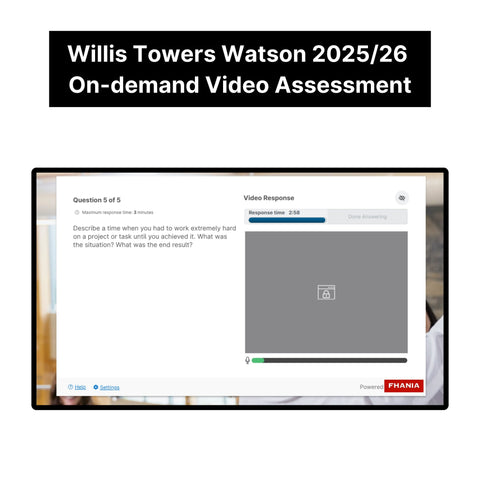
WTW Interview Questions 2027: Tell Me About a Time You Worked in a Team
For this Willis Towers Watson interview question, use STAR with your contribution in focus: the team's goal, your specific role, the actions you took to move the team forward (coordination, unblocking others — not just solo tasks), and the team's result. Be a visible contributor, not a passenger.
Willis Towers Watson Interview Questions: What the Teamwork Question Assesses
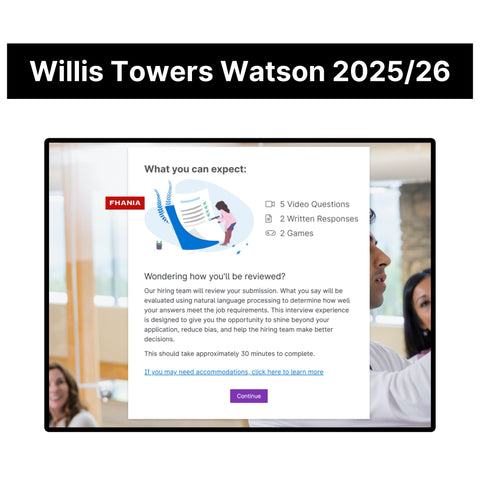
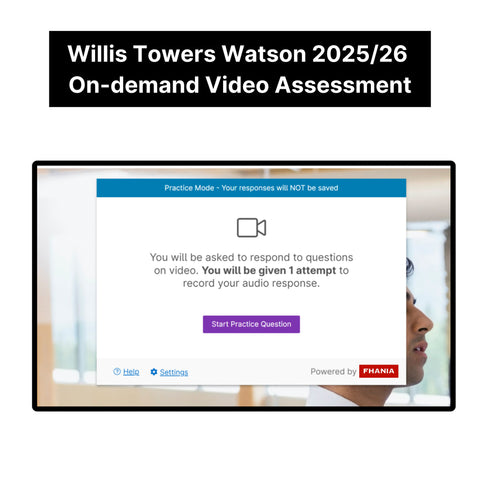
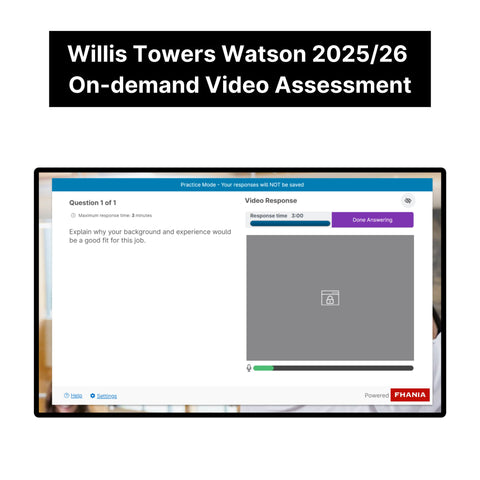
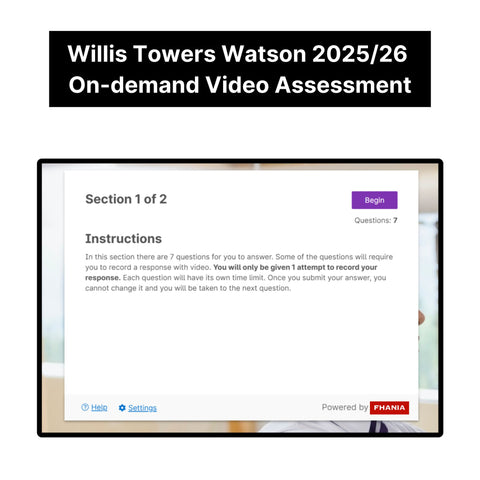
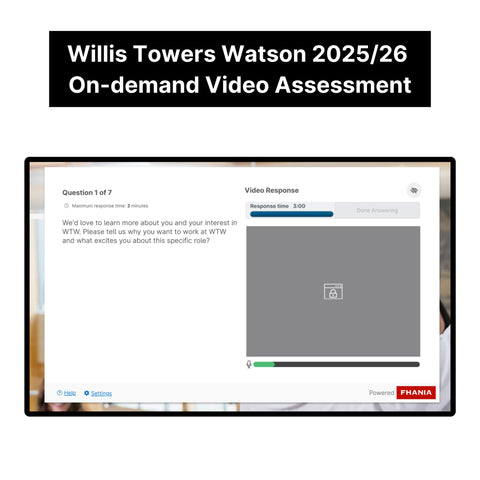
Teamwork questions are commonly reported by candidates in WTW's video assessments because advisory work is fundamentally collaborative — analysts work in engagement teams, learn from seniors, and coordinate with clients. Assessors are testing whether you actively improve team outcomes or merely coexist: did you communicate, resolve friction, help others, and take ownership of shared results? They also watch for balance — candidates who say "I" for everything or "we" for everything both miss the mark.
Willis Towers Watson Interview Questions: How to Answer
Keep the team context but spotlight your actions in STAR:
- Situation. The team, its goal, and what made it challenging — a tight deadline, diverse members, conflicting views. Two lines max.
- Task. Your specific role: "I was responsible for the modelling workstream and for consolidating everyone's sections."
- Action. What you did for the team, not just your deliverable: how you communicated (regular check-ins, shared docs), how you handled a disagreement or a struggling member, where you went beyond your lane to unblock someone else. This is the scored section.
- Result. The team's outcome — quantify if possible — and your reflection: one thing the experience taught you about working with others.
Example line: "In our four-person capstone team, I owned the data analysis but also set up a shared tracker and weekly 20-minute syncs after noticing work was drifting. When two members disagreed on methodology, I proposed we test both on a data subset and let evidence decide — we delivered two days early with the top mark, and it taught me that small coordination habits prevent most team problems."
Common Mistakes
- All "we," no "I." The assessor can't score your contribution if it's invisible.
- All "I," no "we." Taking sole credit for team wins reads as poor collaboration.
- No friction. Teams without any difficulty make for flat stories — a small, honestly-handled conflict adds credibility.
Keep Reading
- moelis maximize irr pe
- KKR Behavioral Interview: Why KKR Questions
- KKR Case Interview: Two-Business Comparison Guide
FAQ
Should the example be academic or professional? Either — pick the team with the clearest goal, real collaboration, and a concrete outcome.
What if I was the leader? Fine, but emphasize enabling behaviors (coordination, unblocking) over directing.
How do I handle a story where the team failed? Honest failure with clear learning works — focus on what you'd do differently.
Can I use a sports or society team? Yes, if the collaboration dynamics are substantive and transferable.
Preparing for Willis Towers Watson's interview? Our 2027 Willis Towers Watson WTW On-demand Video Assessment Exact Questions and Answers has practice questions and answers — $79 one-time, instant download.