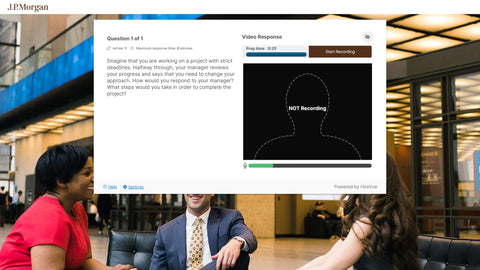
J.P. Morgan runs a HireVue video interview for its 2027 Commercial and Investment Bank Markets Summer Analyst Program, Research, in Hong Kong, and it cuts a large share of applicants before a person watches a single clip. The people who get through have usually rehearsed the real questions. This is a single question interview, Question 1 of 1, with two minutes to answer. It is a behavioral prompt, and behavioral prompts are where nervous candidates give safe, empty answers. The desk is not testing whether you can take orders. It is testing whether you stay useful when the plan changes.
Here is the question, word for word:
Imagine that you are working on a project with strict deadlines. Halfway through, your manager reviews your progress and says that you need to change your approach. How would you respond to your manager? What steps would you take in order to complete the project?
There are two failure directions built into this, and the prompt is watching for both. Get defensive and you look uncoachable. Nod and comply with no thought and you look like you cannot manage your own work. The answer lives in the middle: take the feedback well, understand it, then run a real plan to still hit the deadline.
How you lose points
- You get defensive. Explaining why your original approach was fine reads as someone who argues with their manager instead of listening.
- You comply with no questions. Just saying yes and switching shows no judgment. You do not even know what to change yet.
- You give no concrete steps. The question asks what steps you would take. An answer that is all attitude and no plan misses half the prompt.
- You ignore the deadline. The word strict is doing work. Changing approach halfway costs time, and a good answer treats that time as a constraint to manage, not a detail to skip.
- You make it about your feelings. Talking about how you would feel frustrated but push through is not what they asked. They want the actions.
- You never circle back to the manager. Changing course silently and hoping is not it. Confirming the new direction and setting checkpoints is part of the job.
How you pass
A strong answer starts with the reaction. You thank the manager for catching it now rather than at the deadline, and you do not take it personally, because a review exists to improve the work. Then you get specific before you move: you ask what in particular is off and what the better approach looks like, so you are solving the real problem and not guessing. That short exchange is what separates someone who listens from someone who just obeys.
Then you lay out the steps. You reassess the scope against the deadline and sort the work already done into what still carries over and what has to be redone, so no effort is wasted and nothing salvageable is thrown away. You re-prioritize around the new approach, doing the highest impact pieces first in case time runs short. If the change genuinely puts the deadline at risk, you flag that early with options, for example a trimmed scope or a short extension, rather than staying quiet and missing it. You agree on a quick checkpoint so the manager can confirm you are back on track, then you execute and keep them updated. Close on the trait this reveals: you are coachable and you own delivery, which is exactly the mix a Research desk wants in an analyst who will be handed changing priorities constantly.
Get the ones for your role
This is the only question in the interview, and it rewards people who have a real structure ready rather than people improvising composure in three minutes. The full J.P. Morgan Markets question pack is on OpenInterview if you want to see the real prompts across the Sales, Trading, and Research roles before you record.