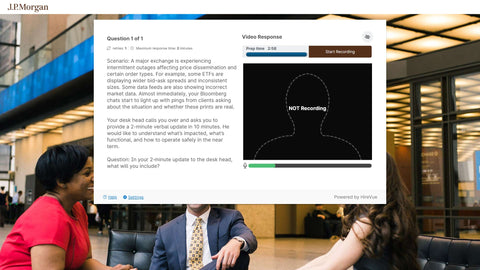
J.P. Morgan runs a HireVue video interview for its 2027 Commercial and Investment Bank Markets Summer Analyst Program, Research, in Hong Kong, and it cuts a large share of applicants before a trader watches a single clip. The people who get through have usually rehearsed the real questions. This is a single question interview, Question 1 of 1, with close to three minutes of prep and two minutes to answer. It is a markets judgment scenario, and the desk head has quietly handed you the grading rubric inside the prompt. Miss that and you will fill two minutes with the wrong things.
Here is the question, word for word:
Scenario: A major exchange is experiencing intermittent outages affecting price dissemination and certain order types. For example, some ETFs are displaying wider bid–ask spreads and inconsistent sizes. Some data feeds are also showing incorrect market data. Almost immediately, your Bloomberg chats start to light up with pings from clients asking about the situation and whether these prints are real.
Your desk head calls you over and asks you to provide a 2-minute verbal update in 10 minutes. He would like to understand what's impacted, what's functional, and how to operate safely in the near term.
Question: In your 2-minute update to the desk head, what will you include?
The desk head told you exactly what he wants: what is impacted, what is functional, and how to operate safely in the near term. Three buckets. The trap is that under pressure people ignore the structure and either dump every detail they can think of or drift into guessing why the exchange went down, which is not what was asked and not something you can verify.
How you lose points
- You ignore the three buckets. He named impacted, functional, and safe operation. An update that does not follow that shape reads as someone who did not listen.
- You speculate on the cause. Guessing why the outage happened is unverified and off topic. The desk head asked about impact and safe operation, not root cause.
- You confirm suspect prints. Telling clients the bad market data is real, or acting on it yourself, spreads unverified information and can move markets.
- You stay vague. No named ETFs, order types, or feeds. A brief with no specifics gives the desk head nothing to act on.
- You blow the two minutes. Trying to cover everything with no priority means you run out of time before the safe operation part, which is the part that protects the desk.
- You forget the clients. The Bloomberg pings are in the scenario for a reason. An update that ignores how to handle client questions is incomplete.
How you pass
A strong answer opens with a one line headline, then walks the three buckets the desk head named. Impacted: the specific ETFs quoting wider bid to ask spreads with unreliable sizes, the order types the exchange is failing to handle, and the data feeds showing incorrect market data. Functional: which products, venues, and feeds still look reliable, so the desk knows where it can still work with confidence. Safe operation in the near term: verify every print against a second data source before quoting or trading it, use limit orders rather than market orders so you are not filled at a broken level, widen caution and cut size on the affected names, and do not act on or repeat prices you cannot confirm.
Then handle the clients cleanly, because that is the live pressure in the scenario. Tell them plainly that you are aware of the exchange issue and are confirming which prints are valid, and do not tell anyone a suspect price is real until you have checked it. Close the two minutes the way a desk head wants it closed: say what you will keep watching, whether the feeds are recovering and whether spreads are normalizing, and when you will update next. Keep the whole thing tight and ordered. The insight the interviewer is grading is whether you can turn a noisy, fast moving situation into a calm, verified, structured brief that protects the desk and its clients from acting on data that is not real.
Get the ones for your role
This is the only question in the interview, and it rewards people who have thought through desk scenarios before they sit down, not in three minutes of prep. The full J.P. Morgan Markets question pack is on OpenInterview if you want to see the real prompts across the Sales, Trading, and Research roles before you record.