

'Why WTW?' 2027: How to Answer This Interview Question
For this Willis Towers Watson interview question, use three parts: the role (why this specific function fits your skills), the company (researched WTW-specific reasons — not lines that fit any advisory firm), and the fit (one or two experiences proving you can do the work). Specificity is everything.
Willis Towers Watson Interview Questions: What "Why WTW?" Assesses
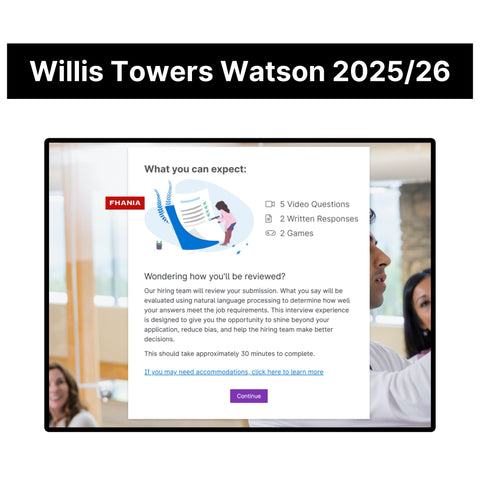
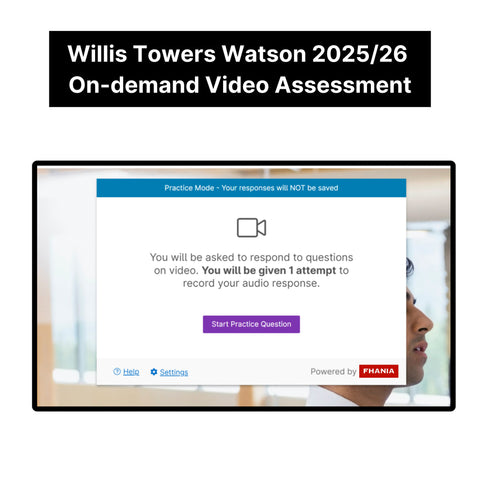
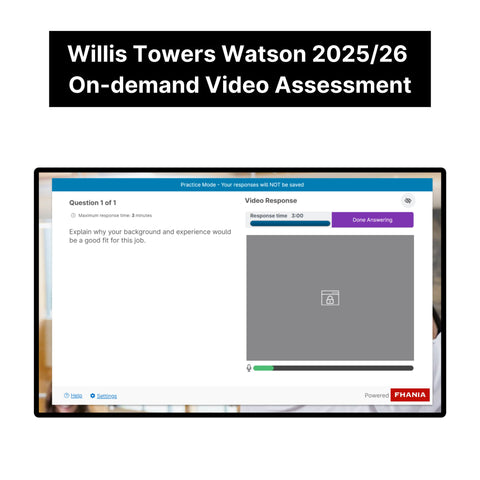
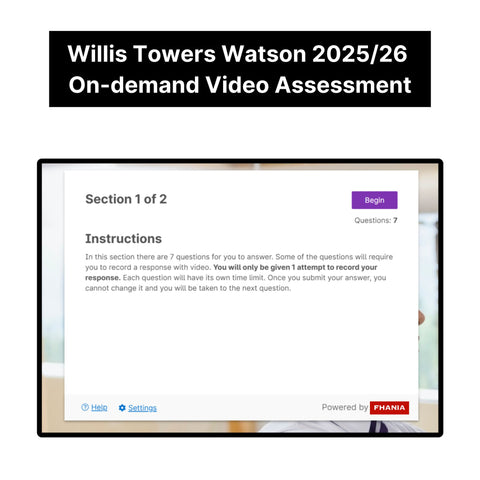
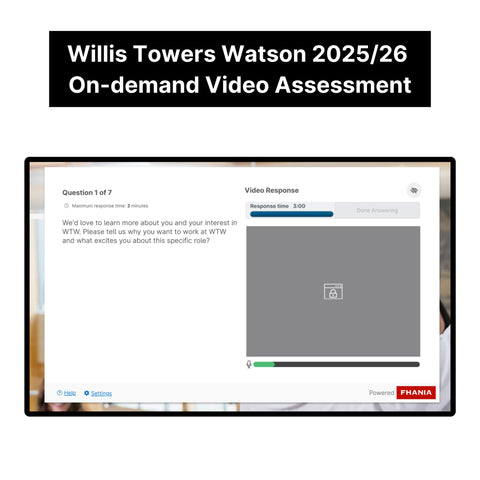
"Why WTW?" is commonly reported by candidates as the opening question of WTW's on-demand video assessment, and it does double duty: testing genuine motivation and filtering out applicants spraying identical answers across firms. Interviewers — human or AI-scored — are listening for role understanding (do you know what the job actually involves day to day?), company research (can you name WTW-specific reasons?), and credible fit (does your background point here, or is this random?). Generic answers are the fastest route to rejection.
Willis Towers Watson Interview Questions: How to Answer
Build the answer in three connected parts:
- The role. Show you understand the actual work: for actuarial roles, that means technical modelling, client communication, and long exam commitment; for consulting, client problem-solving across HR, risk, or benefits. Name the day-to-day realities, not just the title.
- The company. Give WTW-specific reasons grounded in public information: the breadth of its advisory practices, its position advising major employers and insurers, its structured professional development. Reference something concrete from their careers site or recent public materials.
- The fit. Connect your background: quantitative degree, relevant internship, client-facing experience, exam progress — one or two proof points that you can thrive in this specific seat.
Example line: "I'm drawn to the actuarial consulting role because it combines deep technical modelling with direct client impact — that's the mix my maths degree and my client-facing internship each gave me half of. WTW specifically because of the breadth of its practices, which means I'd develop across pensions, insurance, and risk rather than narrowing too early; and I'm already [X] exams into the professional pathway, so I'm committed to the long game this career requires."
Common Mistakes
- Interchangeable praise. If your answer works for any advisory firm, it works for none of them.
- Ignoring the role half. "What excites you about this specific role" is explicit — answer it directly.
- No evidence of commitment. For actuarial paths especially, exam progress or concrete preparation signals seriousness.
Keep Reading
- why jp morgan answer
- How to Answer the Client Markout Reversion Question on the J.P. Morgan
- How to Answer the Communication Success Question on the JPMorganChase
FAQ
How long should a video-assessment answer be? Aim for 60–90 seconds of structured content; check the on-screen timing for your intake, which may vary.
Should I mention WTW's competitors? No — keep every line about why WTW, not why not others.
What if I'm applying to multiple WTW roles? Tailor the role half to the specific seat; the company half can stay consistent.
Can I mention long-term career goals? Briefly — one line connecting the role to your direction is enough.
Preparing for Willis Towers Watson's interview? Our 2027 Willis Towers Watson WTW On-demand Video Assessment Exact Questions and Answers has practice questions and answers — $79 one-time, instant download.