
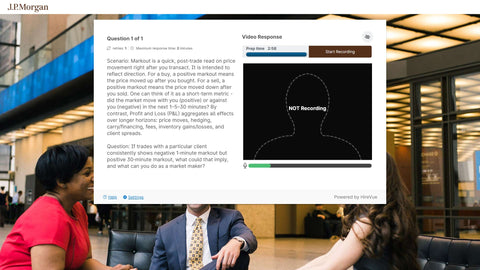
The 2027 Commercial and Investment Bank Markets Summer Analyst Program at J.P. Morgan, the Hong Kong Research role, opens with a recorded HireVue before a human joins the process, and it cuts a lot of people early. The ones who clear it usually practiced the real questions instead of improvising into a webcam. This interview is a single question, Question 1 of 1, with roughly three minutes of prep and two minutes to speak. It gives you the markout definition for free, then shows you a specific client pattern and asks you to explain it. The gift is a trap: repeating the definition is worth nothing.
Here is the exact wording:
Scenario: Markout is a quick, post-trade read on price movement right after you transact. It is intended to reflect direction. For a buy, a positive markout means the price moved up after you bought. For a sell, a positive markout means the price moved down after you sold. One can think of it as a short-term metric - did the market move with you (positive) or against you (negative) in the next 1–5–30 minutes? By contrast, Profit and Loss (P&L) aggregates all effects over longer horizons: price moves, hedging, carry/financing, fees, inventory gains/losses, and client spreads.
Question: If trades with a particular client consistently shows negative 1-minute markout but positive 30-minute markout, what could that imply, and what can you do as a market maker?
Focus on the split. One minute out, the price is working against your new position, so you look like you got run over. Thirty minutes out, the price has swung back and you are in profit on the move. The early damage undoes itself. That reversal is the signal, and everything you say about the client and your hedging should follow from it.
Where candidates go wrong
- Reciting the definition. The scenario already spells out what markout is. The interviewer wants your read of the pattern, not the glossary.
- Labeling the client toxic. Genuinely toxic flow stays negative as time passes. This one turns positive by thirty minutes, so the toxic label misreads the data.
- Not naming the reversion. The whole story is a temporary move that mean reverts. If you never say that, you have described the numbers without explaining them.
- Hedging hard in minute one. Rushing to flatten right after the fill crystallizes the adverse move just before it reverses. The pattern is telling you not to do that.
- Diagnosing but not acting. The prompt asks what you can do. A reason with no response leaves half the marks on the table.
- Trusting a thin sample. Confirm the pattern is consistent across trades and conditions before you retune quotes, so you are not fitting to a handful of prints.
What a strong answer does
A strong answer explains the reversal. In the first minute after the fill, the price pushes against your position, which on a short read looks like adverse selection. By thirty minutes it has returned and the markout is positive, so the early move was temporary: it can be your own hedging nudging the price, the client's order creating brief impact, or flow that leans into short lived noise that fades. The takeaway is that this client is not carrying information that lasts. You were not truly picked off, you just clocked the worst point of a move that comes back.
Then lay out the levers. Stage the hedge instead of dumping it into the first minute, since hedging into the temporary drift is what converts a reverting trade into a booked loss. Hold or internalize more of the position to earn the reversion rather than paying the spread to get flat instantly. Skew your quotes so you are compensated for the short term drift you absorb, and reserve widening for the day the pattern stops coming back. Keep the measurement running: watch the markout curve by client and by horizon so you know the reversion is durable before you lean on it. Close on the trader's discipline: the one minute number tells you when it stings, the thirty minute number tells you whether it mattered, and you time your hedging to the reversion instead of flinching at the first tick.
Get the ones for your role
This is the whole interview, one question, and it favors people who can turn a markout pattern into a hedging decision rather than people who can define the term. OfferTutoring keeps the full J.P. Morgan Markets question set if you want the real prompts for the Sales and Trading roles in front of you before you record.