UBS Logical Reasoning Test: Question Types & Tips
The UBS Logical Reasoning Test presents deduction puzzles — syllogisms, seating arrangements and "if-then" chains — where each question builds on strict logic rules. It is often adaptive, meaning the questions get harder as you answer correctly, so early mistakes do not just cost points: they cap how high your score can go.
What Is the UBS Logical Reasoning Test?
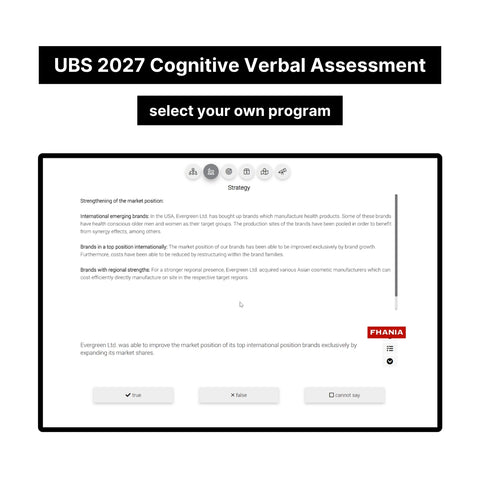
The UBS Logical Reasoning Test is the deduction module of the UBS Online Assessment. Typical questions look like: "All traders on desk A handle equities. Some equity handlers also cover derivatives. Which conclusion must be true?" Others involve ordering puzzles (who sits where given five constraints) or conditional chains ("If the deal closes in Q1, the team expands; the team did not expand — what follows?"). No prior knowledge is needed — only the ability to follow rules precisely under time pressure.
The Question Types in the UBS Logical Reasoning Test
Three types dominate the UBS Logical Reasoning Test. Syllogisms test whether a conclusion necessarily follows from two premises — the trap is choosing what sounds plausible instead of what is logically forced. Arrangement puzzles give you a set of constraints and ask what must or cannot be true; the winning method is drawing a quick diagram rather than holding it all in your head. Conditional logic ("if P then Q") tests contrapositives: candidates constantly affirm the consequent, a classic error. In adaptive versions, the difficulty ramps with each correct answer, so the test feels harder the better you are doing — which is actually good news.
How to Prepare for the UBS Logical Reasoning Test
Prepare by learning the five deduction patterns cold: syllogism validity, contrapositive, arrangement diagramming, "only if" versus "if", and elimination grids. Practice untimed first and write out the reasoning for every answer — speed without accuracy is worthless in an adaptive test, because early errors lower the ceiling for your whole section. Once accuracy is above 90% untimed, add the timer and practice recovering from a hard question without panic: skip strategically, because one stuck question can eat the time for three easy ones. Our tutorial pack includes UBS Logical Reasoning Test questions with step-by-step deduction explanations, so you learn the method behind each type instead of just checking answers.
Because the test adapts, the first five questions matter more than the last five. Candidates who warm up cold walk into the highest-leverage questions unprepared — and never get the chance to recover.
FAQ
Is the UBS Logical Reasoning Test adaptive? It is often delivered in an adaptive format: correct answers lead to harder questions. Treat the opening questions as the most important.
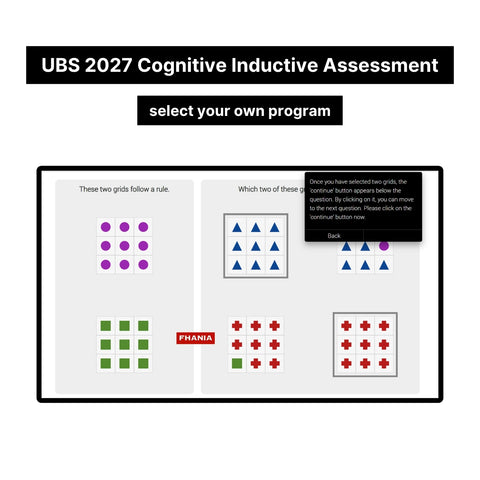
How is it different from the inductive reasoning test? Logical reasoning uses verbal and symbolic deduction puzzles; inductive reasoning uses visual patterns and sequences. UBS tests both separately.
Do I need to study formal logic? No. The underlying patterns are simple; what you need is practice recognizing them quickly.
What is the most common mistake? Choosing the answer that sounds true in real life instead of the one that must be true from the premises. Logic, not intuition.
Preparing for UBS's Online Assessment? Our 2027 UBS Online Assessment and ModernHire Video Interview Answers has the exact questions and answers — $79 one-time, instant download.