

RWE Inductive Reasoning Test 2027: Matrices & Sequences
The RWE inductive reasoning test asks you to find the hidden rule in a series of shapes, numbers, or patterns and predict what comes next. You get a sequence with one element missing and several options. It is pure logic — no maths knowledge, no vocabulary — and it rewards candidates who can think in rules rather than details.
What the RWE Inductive Reasoning Test Is
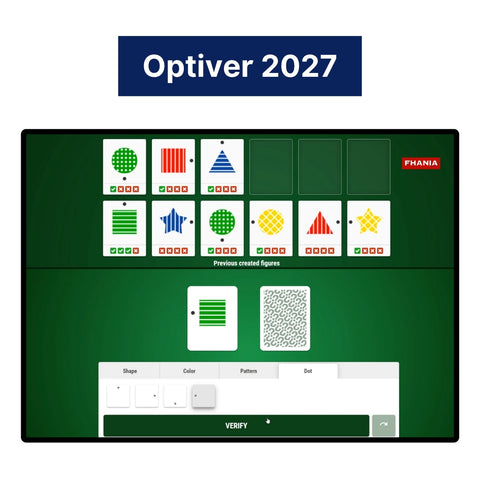
The RWE inductive reasoning test is the abstract logic component of RWE's 2027 intake assessments. Questions present sequences of figures — shapes that rotate, grow, change colour, appear and disappear — or number and letter series. Your task is to identify the underlying rule and select the element that continues the pattern.
Unlike deductive tests, you are not given the rule — you must discover it from examples, which is why it is called inductive. Tests are timed, typically allowing around a minute per question.
What the RWE Inductive Reasoning Test Measures
The RWE inductive reasoning test measures fluid intelligence — handling novel problems you have never seen before. Graduate roles constantly throw unfamiliar situations at you, so the test is a proxy for how fast you will learn on the job.
Specifically, it scores pattern recognition speed, hypothesis testing (can you propose a rule and check it against all examples?), and resistance to distraction — many sequences include elements that change randomly to hide the real pattern. Candidates who fixate on the noise never find the signal.
How to Prepare for the RWE Inductive Reasoning Test
Learn the standard rule families: rotation, reflection, alternation, progression (steady increase or decrease), and set operations (elements combining or cancelling). For every sequence, state a hypothesis explicitly — "shapes rotate 90 degrees clockwise each step" — then verify it against every element before looking at the options.
Work backwards from the answer options when stuck: test each option against your partial rule. Drill under time pressure — the test gives you about 60 seconds, so train yourself to commit to a hypothesis fast rather than hunting for certainty.
Our 2027 RWE Standardised Assessment Online Analytics Test and Tutorials includes full inductive reasoning sets with rule-by-rule explanations that teach you to spot each pattern family on sight — $79 one-time, instant download.
Inductive reasoning is the test candidates practise least, because it feels like something you either "get" or you don't. That belief is wrong — pattern families are learnable, and every hour of drill converts directly into faster recognition. Your competition is skipping this preparation. Don't be your competition.
FAQs
What is the difference between inductive and deductive reasoning tests? Inductive: you discover the rule from examples. Deductive: you are given the rule and apply it to reach a conclusion. RWE may test both in the 2027 intake.
How much time per question? Typically around one minute. If you have no hypothesis after 40 seconds, eliminate and guess — blank answers score zero.
Do number sequences appear as well as shapes? Yes — expect figural series (shapes) plus numerical and alphabetical series. The rule families overlap: progression, alternation, and interleaved patterns appear in all formats.
Can you improve at inductive reasoning? Absolutely. It is one of the most trainable test types — learning the common rule families typically lifts scores by a full grade band within a few practice sessions.
Preparing for RWE's Inductive Reasoning Test? Our 2027 RWE Standardised Assessment Online Analytics Test and Tutorials has the exact questions and answers — $79 one-time, instant download.