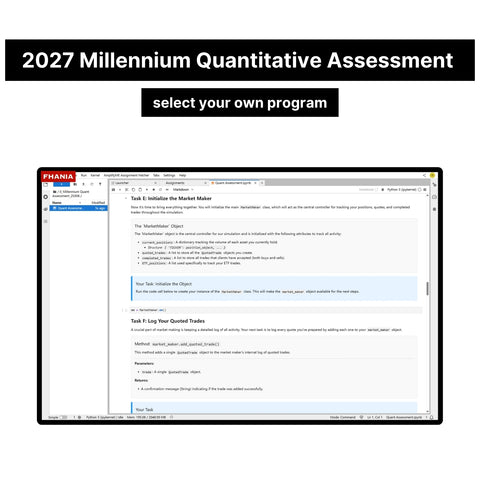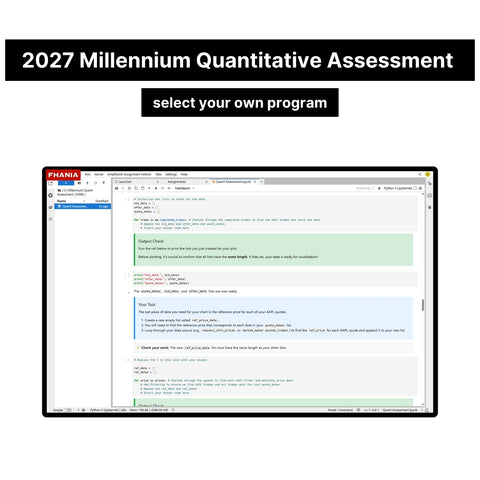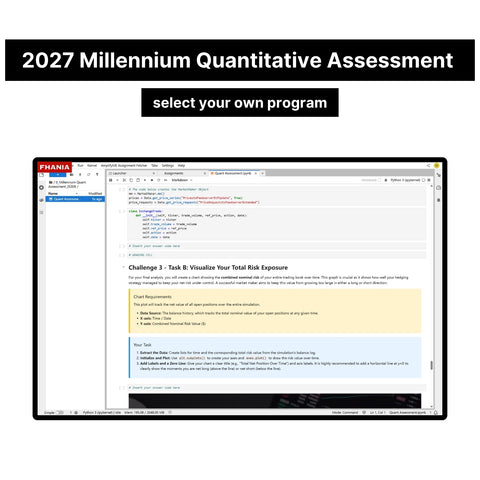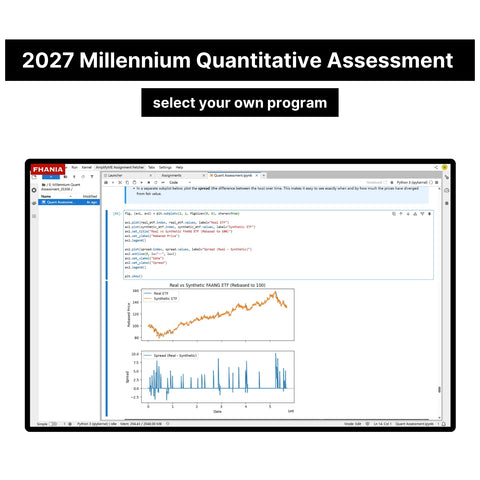


Millennium Quantitative Assessment: Format Explained
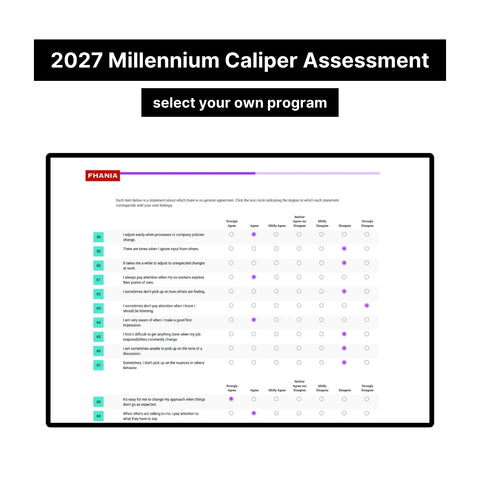
The Millennium quantitative assessment is the technical filter for quant and research roles: timed math, probability, and statistics problems that decide whether you reach the interview. It is not a school test — it is a speed test of the fundamentals every quant uses daily. Here is the format and how it is scored.
What the Quantitative Assessment Is
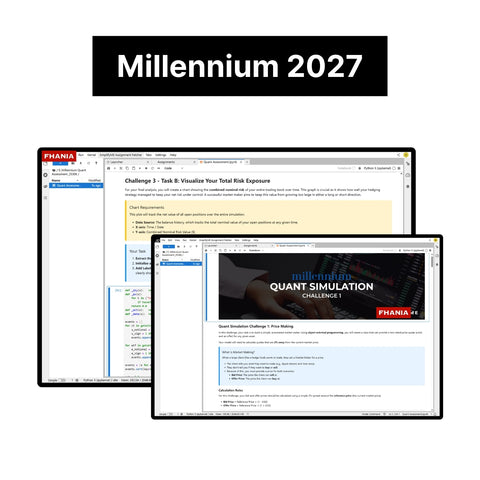
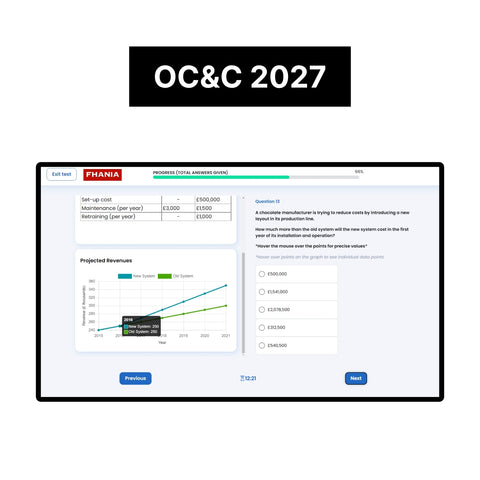
After the Caliper screen, quant-track candidates receive the Millennium quantitative assessment: a timed online test covering probability, statistics, combinatorics, linear algebra basics, and mental arithmetic. Expect questions like dice-and-card probability, expected value calculations, and quick estimation under a tight clock. The format is multiple-choice or short numerical answers, and the test is calibrated so that a strong math student who has not practiced timed problem-solving will feel rushed — that is by design.
What the Quantitative Assessment Tests
It tests fluency, not brilliance. The Millennium quantitative assessment measures how fast and accurately you handle the mathematical primitives of trading: probability distributions, expected value, variance intuition, conditional probability, and order-of-magnitude estimation. Millennium's desks live on these; the assessment checks whether your fundamentals are automatic or whether you need ten minutes and a whiteboard. Accuracy matters, but pace decides — a candidate who solves 80% quickly outscores one who solves 40% perfectly.
How to Prepare for the Quantitative Assessment
Rebuild fundamentals at speed. Drill probability and expected-value problems daily with a countdown, not a textbook — the failure mode is knowing the formula but taking three minutes to apply it. Our 2027 Millennium Caliper Assessment and Quantitative Assessment Exact Questions and Answers contains the exact quantitative assessment questions and answers used in the 2027 cycle, including the probability, statistics, and mental-math formats Millennium actually asks — $79 one-time, instant download. Work through every question timed, review the solving logic, and repeat until the standard patterns (bayes, EV, variance shortcuts) fire instantly.
The FOMO Angle: Weak Foundations Fail Fast
Quant roles at a top multi-manager fund get thousands of applications from math olympiad medalists and PhDs. The quantitative assessment is where most of them die — not because they cannot do the math, but because their fundamentals are not fast enough. If your probability intuition needs warm-up, you are already behind candidates who drilled the exact question formats. This filter does not reward potential; it rewards preparation. The prepared candidate walks out of the timed test calm. The unprepared one runs out of clock.
FAQ
How hard is the Millennium quantitative assessment? Hard for the unprepared, mechanical for the prepared — it tests speed on probability and statistics fundamentals, not advanced theory.
How long is the quantitative assessment? It is a timed online test; treat it as a sprint and verify the exact timing in your invitation for the 2027 intake.
Can you retake the quantitative assessment? Generally no retake within the same cycle — assume one attempt per recruiting season.
What topics should I study? Probability, expected value, conditional probability, combinatorics, basic statistics, and fast mental arithmetic.
Preparing for Millennium's quantitative assessment? Our 2027 Millennium Caliper Assessment and Quantitative Assessment Exact Questions and Answers has the exact questions and answers — $79 one-time, instant download.