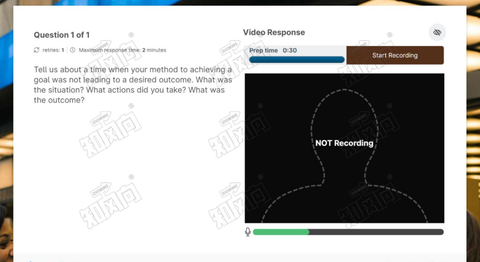
The 2027 JP Morgan CIB Markets Video Interview asks for more than a recovery story. It tests whether you can update your approach when the evidence stops supporting it. A useful answer lets the listener inspect the signal you noticed, the assumption you challenged and the improvement created by your change.
The actual interview question
The prompt on screen is:
Tell us about a time when your method to achieving a goal was not leading to a desired outcome. What was the situation? What actions did you take? What was the outcome?
How you lose points
- Doubling down without diagnosis. "I kept using the same approach and worked harder until it succeeded." shows effort but no adaptation.
- Giving the decision to the group. "The plan was not working, so my team decided to change direction." leaves your observation and judgment invisible.
- Replacing evidence with a lesson. "I learned to be flexible, and the outcome was successful." never proves what changed.
- Making an unexplained pivot. A new tactic has little value if you cannot connect it to the cause of the problem.
- Forgetting the goal. A creative change that does not improve the required outcome is still the wrong method.
How you pass
Use a three-part decision trail. First, spot the signal and show exactly what told you the method was failing. Second, diagnose the cause by testing the assumption behind the original plan. Third, change and measure: describe your revised action, the effect it produced and the result against the original goal.
- Spot the signal. Name the missed milestone, weak response, error rate or other evidence that forced a review.
- Diagnose the cause. Explain what you checked and which assumption no longer held.
- Change and measure. Show the action you owned, how you monitored it and what improved.
Hypothetical example: Suppose a candidate promotes a campus event through broad social posts, but registrations remain flat after one week. The candidate checks referral data and learns that interested students need clearer information about the speakers. She replaces generic posts with short speaker clips, contacts relevant societies directly and tracks registrations by source. Sign-ups then exceed the target, with society referrals producing most of the increase.
The strongest version of this story is not about abandoning a plan quickly. It is about using evidence to decide when persistence has stopped being useful.
Get the ones for your role
This question covers one decision pattern in the JP Morgan CIB Markets Video Interview. OfferTutoring has the complete questions for this role so candidates can rehearse the different evidence each prompt requires.