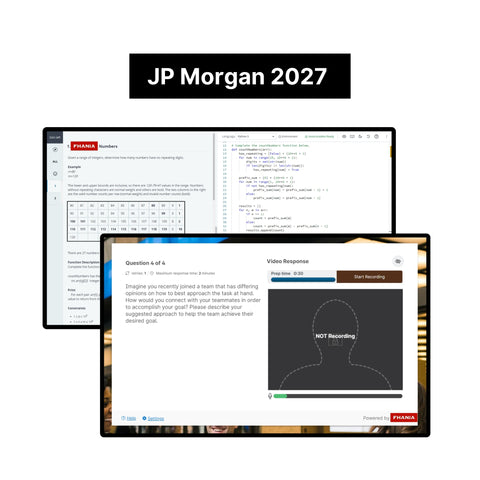

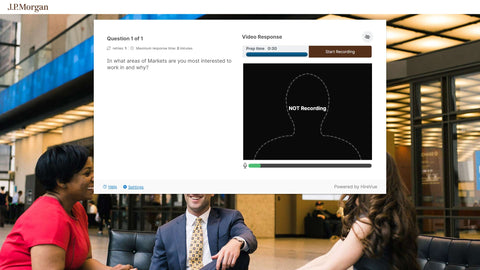
The 2027 Commercial and Investment Bank Markets Summer Analyst Program at J.P. Morgan, the Hong Kong Research role, opens with a recorded HireVue before a human joins the process, and it cuts a lot of people early. The ones who clear it usually practiced the real questions instead of improvising into a webcam. This interview is one question, Question 1 of 1, and this prompt gives you only about thirty seconds to prepare before you talk for up to two minutes. It looks like a soft opener, but it is really a check on whether you understand the floor you are trying to join.
Here is the exact wording:
In what areas of Markets are you most interested to work in and why?
What makes it hard is the short fuse. Thirty seconds is not enough to invent a real view, so vague answers expose themselves fast. The candidates who prepared a specific interest and a reason behind it sound like they belong; everyone else sounds like they are guessing on camera.
Where candidates go wrong
- Saying you would be happy anywhere. No preference reads as no thought. The desk is listening for a point of view, not flexibility.
- Describing Investment Banking by mistake. If you mention deals or advisory, you have shown you do not know Markets is Sales and Trading. That is a fast way to lose the interviewer.
- Naming a product with no reason. Rates or equities on its own is a label. The question literally asks why, so the reason is the answer.
- Forgetting this is a Research seat in Asia. The role is Markets Research in Hong Kong. An answer that never touches analysis or the region sounds recycled from another application.
- Reciting what an asset class is. Defining a bond or an option burns your time. They want your interest, not a lecture.
- Wandering with no structure. With so little prep, an unplanned answer drifts across three areas and lands nowhere. One clear pick wins.
What a strong answer does
A strong answer commits to one or two specific areas and explains the fit. Pick a real part of the floor, equities and equity derivatives, rates, foreign exchange, credit, or commodities, and link it to how your mind works. If you like quick feedback and clear cause and effect, equities or foreign exchange suits you, because you can form a view and watch the market grade it inside a session. If you are drawn to macro and to turning policy into a price, rates fits, and you can talk about how Asian central bank moves feed the curve. Since this is a Research seat in Hong Kong, tie the interest back to analysis and to the region: you want to understand what moves a market and put that view into words, and Asia interests you because its flows and policy are in motion.
Then prove it is real with one concrete detail. Reference a market you actually follow, a trade idea you reasoned through, a recent move in Asian rates or a currency you hold a view on, and say what watching it taught you. Keep the shape clean: name the area, give the reason it matches how you think, and add one sign the interest is genuine. Finish on grounded openness: you lean toward this area now and you want the internship to sharpen and widen that across the desk. That mix of a real preference and a willingness to learn is what a Markets team hopes to hear from an intern.
Get the ones for your role
This is the whole interview, one question, and with thirty seconds of prep it favors people who arrived with a real view rather than people building one live. OfferTutoring keeps the full J.P. Morgan Markets question set if you want the real prompts for the Sales and Trading roles in front of you before you record.