BCG Case Interview Examples: Real Prompts & Frameworks That Work
BCG case interview examples revolve around real business problems — market entry, profitability decline, pricing, growth strategy — and the frameworks that work are always custom-built, never memorized templates. Studying real BCG-style prompts is the fastest way to learn what good structure actually looks like under pressure.
What BCG Case Interview Examples Look Like
Real BCG case interview examples follow a pattern. A classic prompt: "Our client is a European airline whose profits have fallen 20% in two years. What should they do?" Another common type: "A consumer goods company is considering entering the Southeast Asian market. Should they?" What separates BCG examples from generic casebooks is the candidate-led structure. You will not be handed a question sequence; you must generate the structure, the hypotheses, and the data requests yourself. The examples below that matter are the ones that show this in action — a strong opening structure, two or three targeted analyses, and a recommendation that ties directly back to the numbers.
What BCG Case Interview Examples Teach You
Working through BCG case interview examples teaches the three skills BCG actually scores. First, structuring: breaking a messy prompt into a MECE, hypothesis-driven tree in under two minutes. Second, quantitative execution: clean mental math on exhibit data without losing the thread. Third, synthesis: turning analysis into a recommendation a CEO could act on.
The trap is studying examples passively. Reading a perfect solution teaches you nothing about performing one. BCG interviewers can spot candidates who memorized frameworks instantly — the structure sounds right but collapses the moment an unexpected exhibit appears. Examples only work when you attempt the case first, then compare your approach against the real solution.
How to Prepare with BCG Case Interview Examples
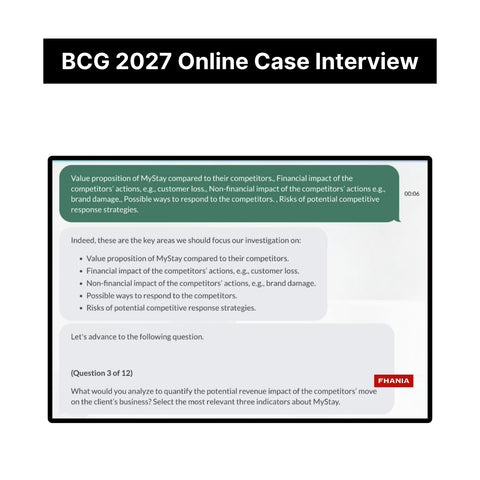
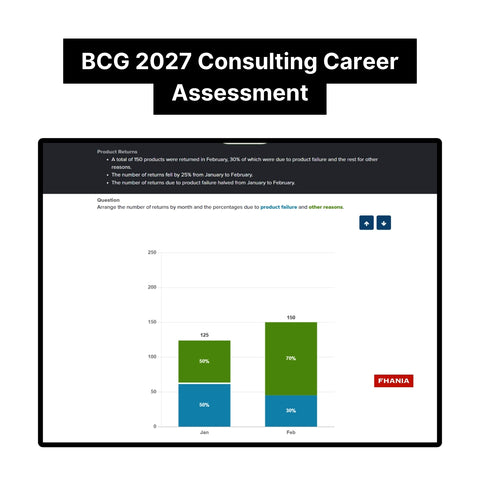
Practice with the real thing. Our BCG prep tutorial includes nine real BCG offline interview cases with complete answers — actual prompts BCG has used, with full solution walkthroughs — plus the HireQuo Online Case assessment and Consulting Career Assessment materials. The method: attempt each case fully on your own with a timer, write down your structure and math, then study the real answer to see where your logic diverged. Keep a log of your repeated mistakes — most candidates find they make the same two or three errors across every case.
Show up with a framework that collapses and the interview is over in twenty minutes. BCG cases reward candidates who have wrestled with real prompts, not candidates who read about them. Every 2027 intake, the people who pass are the ones whose practice volume was on actual BCG-style cases — start that volume now, while there's still time to fix the gaps.
FAQ
How many BCG cases should I practice before interviews? Most successful candidates complete 15-25 full timed cases, each reviewed against a real solution.
Are BCG cases harder than McKinsey's? They are different rather than harder: BCG's candidate-led format demands more initiative, while McKinsey's interviewer-led format is more structured. Prepare for each format specifically.
Do BCG cases always have math? Nearly always. Mental math and exhibit analysis are core to every BCG case — weak quant skills sink candidates fast.
Where can I find real BCG case prompts? Our BCG tutorial includes nine real offline BCG cases with answers, plus the online case and CCA materials — all in one package.
Preparing for BCG's Case Interview? Our 2027 BCG Consulting Career Assessment, Online Case and Quantitative Reasoning Test Tutorials has the exact questions and answers — $79 one-time, instant download.