UBS Inductive Reasoning Test: Patterns & How to Prepare
The UBS Inductive Reasoning Test shows you sequences of shapes, 3x3 matrices and series where you must find the hidden rule and pick the next figure — usually with only seconds per question. If you cannot spot the pattern logic quickly, you will end up guessing, and guessing is how candidates fail a section they could have mastered with practice.
What Is the UBS Inductive Reasoning Test?
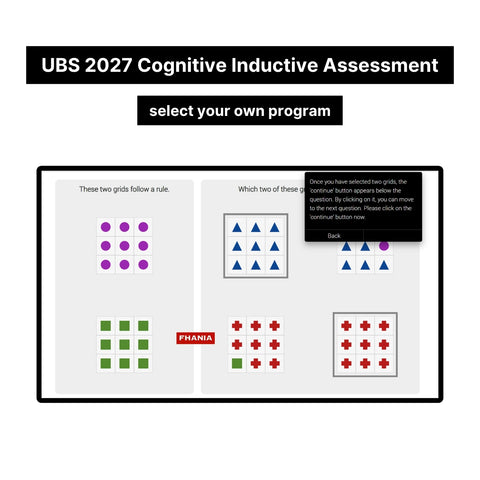
The UBS Inductive Reasoning Test is the pattern-recognition module of the UBS Online Assessment. You are given a series of abstract figures — shapes that rotate, change color, grow, shrink or move position — and must identify the rule governing the sequence, then select the figure that continues it or the odd one out. No math is involved; it is pure visual logic under time pressure, typically around six minutes for a full round.
Which Patterns the UBS Inductive Reasoning Test Uses
The UBS Inductive Reasoning Test recycles a small set of pattern types. The most common: rotation and reflection (a shape turns 45 or 90 degrees each step), progression (number of sides or dots increases by a fixed amount), distribution of three values (each row or column contains the same three elements in different orders), and combination rules (the third figure is made by adding or subtracting elements of the first two). Harder questions layer two rules at once — for example, rotation plus color alternation.
How to Prepare for the UBS Inductive Reasoning Test
Prepare by learning the pattern vocabulary before you ever start the timer. Work through practice sets untimed first, and for every question write down the rule in one sentence: "each step adds one dot and rotates 90 degrees." Once you can name the rule for each type on sight, switch to timed practice — because six minutes means pattern recognition must be reflex, not analysis. Our tutorial pack includes UBS Inductive Reasoning Test practice questions with the rule explained for every answer, so you build a mental library of patterns and stop guessing.
This is the section where practice has the biggest payoff: the patterns do not change, only the shapes do. A candidate who has drilled 50 matrices will see the rule in five seconds; a first-timer will still be staring at it when the clock runs out.
FAQ
How long is the UBS Inductive Reasoning Test? Typically around six minutes per round — one of the most time-pressured sections in the whole assessment.
Do I need to study math for it? No. Inductive reasoning is visual pattern logic; there are no numbers to calculate.
Is guessing penalized? There is no published penalty, but unanswered and guessed questions both score zero — so speed through preparation matters more than caution.
How is it different from the logical reasoning test? Inductive reasoning uses visual patterns and sequences; logical reasoning uses word- or symbol-based deduction puzzles. UBS tests both.
Preparing for UBS's Online Assessment? Our 2027 UBS Online Assessment and ModernHire Video Interview Answers has the exact questions and answers — $79 one-time, instant download.