Temasek Interview Questions 2027: Your Economic Outlook & How to Answer
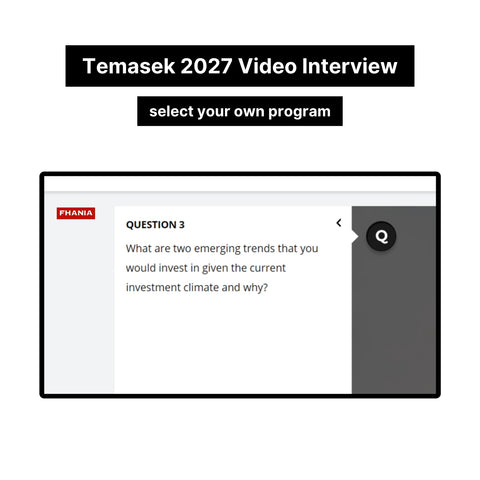
Structure your outlook in three parts: current conditions (stated carefully from verifiable sources, refreshed before the interview), your forward view with reasoning, and the investment implications for a long-term investor — plus the key risks and signposts you'd watch. This Temasek interview question is commonly reported by candidates and tests macro-to-portfolio thinking.
What Temasek Interview Questions Like This Assess
The interviewer isn't asking you to predict the economy — they're asking whether you can form a coherent view, support it with evidence, and connect it to long-term investing. For patient capital, they're especially listening for structural thinking (demographics, productivity, debt cycles) over short-term forecasting, and for intellectual honesty about uncertainty.
How to Answer Temasek Interview Questions: The Conditions-View-Implications Method
- Current conditions: "My read of where we stand: [interest rates / inflation / growth — described from recent data as of now]." Only state what you can verify from reputable sources; macro conditions move fast, so refresh the week of your interview.
- Your forward view: Take a position with reasoning. Example structure: "Looking ahead, my base case is [view — e.g., 'a period of moderate growth with rates settling above the post-2008 lows'], driven by [2-3 structural drivers: fiscal dynamics, productivity trends, demographic shifts]. The alternative scenario I take seriously is [X], which would follow if [Y]."
- Investment implications for long-term capital: "For a long-horizon investor, I'd translate this into [positioning: e.g., 'favouring assets with pricing power and real cash flows that compound through cycles,' 'maintaining duration discipline in fixed income,' 'selective exposure to structural growth themes']. The emphasis is on resilience across scenarios rather than betting on one outcome."
- Risks and signposts: "The key risks to my base case are [X and Y]. I'd watch [specific data releases, policy decisions] — [outcome A] strengthens the case, [outcome B] forces a rethink."
Sample line: "My base case is [view], driven by [drivers] — but I'd hold it probabilistically, with [alternative scenario] as the serious alternative. For long-term capital, the implication is [positioning tilted toward resilience and compounding], while watching [signposts] to test the thesis."
Common Mistakes
- Stale views: An outlook formed months ago can be wrong on arrival. Refresh from current data before the interview.
- Forecasting without humility: Presenting a single certain prediction. Always frame probabilistically with scenarios and signposts.
- No investment translation: Describing the economy without saying what it means for a long-term portfolio misses the question's purpose.
Outlook questions are high-differentiation moments in Temasek interview questions — they separate investors from observers.
Keep Reading
- gsk interview questions
- Temasek Hiring Timeline: From Application to Offer
- Temasek Internship Application 2027: Process & Deadlines
FAQ
How far ahead should my outlook go? Match the institution's horizon: think in multi-year structural terms, not quarterly predictions. 3-5 year base cases with longer structural themes.
What if I genuinely don't know? "Genuinely uncertain, positioned for multiple outcomes" — with reasoning about the scenarios and how you'd invest through them — is a respectable answer. False confidence is not.
Should I discuss specific regions? Yes — a global investor's outlook should be geographic: differentiate across major economies rather than giving one global blob.
How do I handle pushback on my view? Defend with reasoning, acknowledge strong counterarguments honestly. The quality of your thinking under challenge is what's graded.
Preparing for Temasek's interview? Our 2027 Temasek Online Assessment & Video Interview Answers has practice questions and answers — $79 one-time, instant download.