

"Tell Me About a Time You Failed" – Goldman Sachs 2027 Answer Guide
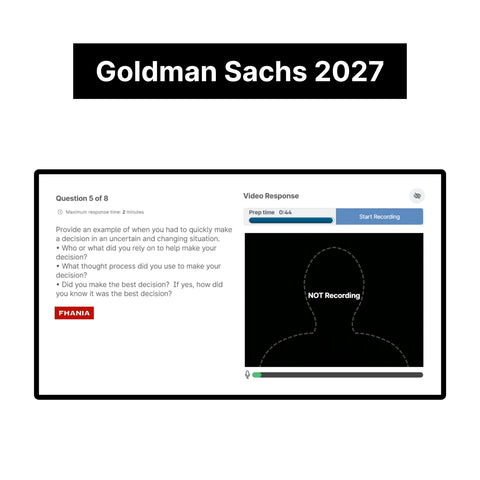
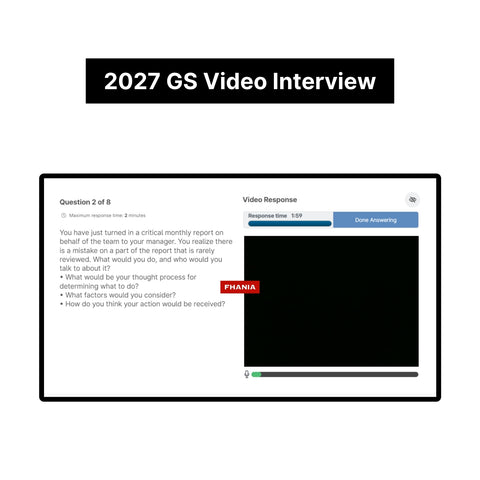
The "Goldman Sachs tell me about a time you failed" interview question is commonly reported by candidates interviewing at Goldman Sachs. Use STAR in about 90 seconds: name the failure plainly, take clear ownership, explain what you changed — a process, a habit, a check — and show the lesson applied later with a better result. Interviewers reward honesty paired with a visible fix; they punish disguised strengths and blame-shifting.
What Goldman Sachs Assesses With "goldman sachs tell me about a time you failed"
This question tests self-awareness and growth, two traits banks screen hard for. Candidates commonly report that the follow-up is where people fail: "What would you do differently?" A real failure with a real correction beats any polished "weakness" every time.
How to Answer: Goldman Sachs "goldman sachs tell me about a time you failed" Question
- State the failure in one or two sentences — no hedging, no minimizing.
- Own your part explicitly, then describe the concrete change you made afterward.
- Prove the lesson stuck: a later situation where you applied it and got a better outcome.
Example phrasing: "I underestimated the time a model would take and missed an internal deadline. Since then I build in a 20 percent buffer and flag risks early — on the next project I finished a day ahead."
Quick Practice Drill
Practice drill: record yourself answering this question twice — once at 60 seconds and once at 90 seconds. Listen back for filler words and vague verbs, then replace them with specific actions. Do two more reps the next day; commonly reported by candidates, the third recording is usually the one that sounds natural.
Common Mistakes
- Disguising a strength as a weakness — "I work too hard" — which interviewers see through instantly.
- Blaming teammates, the timeline, or bad luck instead of owning your part.
- Picking a failure with no lesson, or one so trivial it shows no self-awareness.
Interviewers decide in the first two minutes whether you can do the job — and most candidates walk in with unrehearsed stories. The ones who convert treat every common question as a drill, not a surprise.
Keep Reading
- m&g plc interview questions graduate
- Goldman Sachs Video Interview: Own the Mistake
- Goldman Sachs Video Interview: Treasury Judgment
FAQ
How serious should the failure be?
Real but recoverable — a missed deadline, a flawed analysis, a miscommunication. Avoid anything involving integrity. Rehearse your answer aloud at least three times before the interview — delivery matters as much as content.
Should I pick a finance-related failure?
Only if it is genuine. A clear story from any context works better than a forced one. Rehearse your answer aloud at least three times before the interview — delivery matters as much as content.
What if they ask what others would say about it?
Answer consistently — do not invent praise or shift blame in the follow-up. Rehearse your answer aloud at least three times before the interview — delivery matters as much as content.
Can the story be from school?
Yes. Recent examples are best, but a university story with a clear lesson is fine. Rehearse your answer aloud at least three times before the interview — delivery matters as much as content.
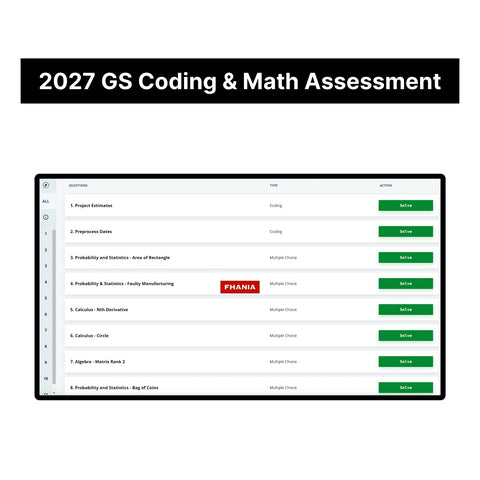
Preparing for Goldman Sachs's interview? Our 2027 Goldman Sachs Video Interview, Coding & Math Technical Assessment Answers has practice questions and answers — $79 one-time, instant download.