Swire Management Trainee 2027: How to Answer the Macro Risks Question
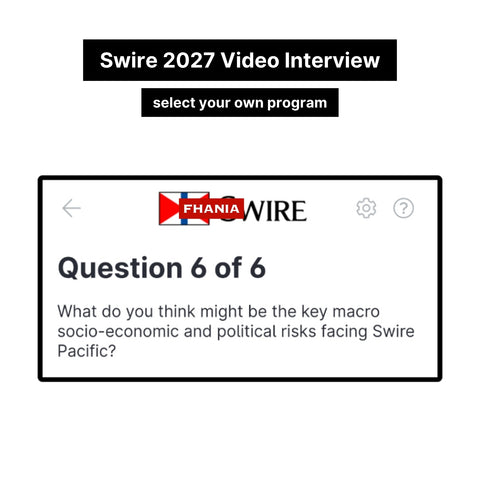
For this swire management trainee interview question, pick two or three macro themes and structure each as risk → transmission → implication: name the risk, trace how it reaches a diversified group like Swire Pacific, and note a sensible management response. Reason from public knowledge — never invent data.
Swire Management Trainee Interview Questions: What the Macro Risks Question Assesses
This question is commonly reported by candidates in Swire Management Trainee interviews, usually in later rounds. It tests commercial awareness and structured thinking: can you reason about how big-picture forces affect a real conglomerate's businesses? Interviewers do not expect economist-grade forecasts — they expect you to pick relevant themes, trace their impact logically, and stay honest about uncertainty. Bluffing with invented statistics is the fastest way to fail it.
Swire Management Trainee Interview Questions: How to Answer
Use one framework per risk, and keep each tight:
- Choose two to three themes. Sensible candidates: economic cycles and consumer demand, geopolitical and trade tensions affecting cross-border businesses, and climate or sustainability pressures on aviation and property. Pick themes you can actually discuss.
- Trace the transmission. For each, explain the channel: e.g., weaker consumer spending hits aviation and beverages demand; trade friction complicates supply chains and cross-border operations; decarbonization pressure raises costs and capex needs in aviation and property development.
- Note the management implication. What would a prudent group do — diversify revenue, invest in efficiency, stress-test the balance sheet? Keep it at the level of sound business judgment, not specific Swire strategy you cannot verify.
- Acknowledge uncertainty. Close with humility: macro outcomes are uncertain, so the real test is resilience and optionality.
Example line: "I'd highlight three: demand cyclicality, which flows straight into aviation and consumer businesses; geopolitical risk, given the group's cross-border footprint; and the energy transition, which reshapes aviation economics over the long term. The common implication is balance-sheet discipline and diversified earnings."
Common Mistakes
- Inventing facts. Never quote growth rates, policy details, or company figures you cannot verify.
- Listing without linking. Ten risks with no transmission mechanism is noise; two risks traced well is signal.
- Only doom. Balance risks with how a well-run group mitigates them — interviewers want judgment, not pessimism.
Keep Reading
- swire group rejected after interview
- point72 tell me about yourself
- Swire Group Case Study 2027: Property Scenarios & Discussion Tips
- Swire Group Case Interview 2027: Virtual Group Format Guide
FAQ
How current should my examples be? Use themes that are clearly live in public discussion, but avoid claiming specific recent events as facts unless you are sure.
Should I focus on one Swire business? No — the question is about the group, so show you can think across aviation, property, and consumer businesses at a high level.
What if the interviewer challenges my view? Welcome it — defend your logic calmly and concede where evidence is thin; the reasoning is being tested, not the conclusion.
How long should the answer be? Two to three minutes: enough for depth on two risks, short enough to invite discussion.
Preparing for Swire Group's interview? Our 2027 Swire Group Video Interview and Online Assessment Exact Questions and Answers has practice questions and answers — $79 one-time, instant download.