SIG vs Jane Street: Which Interview Is Harder?
SIG vs Jane Street is the classic market-maker interview comparison: both are elite, both pay at the top, but they test different things. Jane Street's interview is famous for deep probability and OCaml-flavored reasoning; SIG's leans on timed CodeSignal coding, fast problem solving, and poker-culture trading games. Picking the wrong preparation for the right firm is how strong candidates fail both.
How the Two Interviews Differ
The SIG vs Jane Street interview comparison breaks down by stage:
- Online assessment: SIG uses CodeSignal (4 timed coding questions) plus a problem solving test (logic, numerical, probability). Jane Street uses probability-heavy games and mental math with less emphasis on standard coding tests.
- Probability depth: Jane Street goes deeper — multi-layer conditional probability and estimation games. SIG tests probability too, but under tighter time pressure and alongside coding.
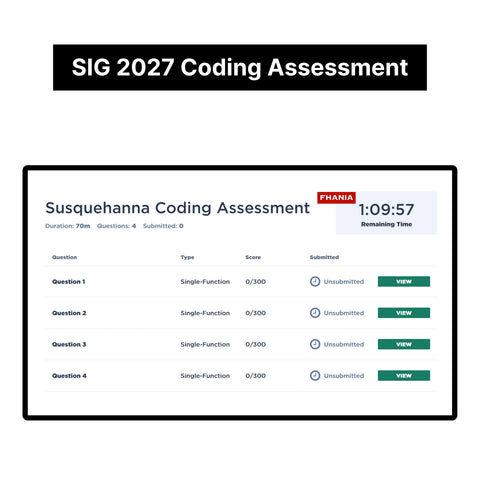
- Coding: SIG's CodeSignal round is a hard gate with the notorious bouncing ball simulation. Jane Street's coding (for tech roles) is rigorous but less central for traders.
- Culture rounds: SIG leans into poker and game theory culture; Jane Street leans into intellectual debate and functional-programming-flavored reasoning.
Which Is Harder?
"Harder" depends on your profile. Strong coders with fast implementation skills often find SIG's CodeSignal the tougher gate and Jane Street's probability depth more natural. Math Olympiad types frequently find Jane Street's layered probability harder and SIG's timed coding more comfortable. The honest answer: each firm is hardest for candidates whose strengths don't match its filter — which is exactly why the firms designed them that way.
How to Prepare for Each
- Don't cross-prepare. SIG vs Jane Street preparation is not interchangeable. SIG demands timed CodeSignal reps and the bouncing ball simulation; Jane Street demands deep probability and estimation practice.
- Match prep to the actual test. For SIG, drill the exact 4 CodeSignal questions and problem solving patterns. For Jane Street, drill probability depth and mental math games.
- Apply to both, prepare separately. The processes run in parallel; treat them as two different exams.
Our 2027 SIG Susquehanna Online Problem Solving | Coding Assessment Tutorials cover the exact SIG side of this comparison — the CodeSignal questions, problem solving patterns, and interview questions — with answers and walkthroughs.
Preparing for the Wrong Firm Is Preparing to Fail
The SIG vs Jane Street debate misses the point if it doesn't change your preparation. Candidates who grind Jane Street-style probability for SIG's CodeSignal arrive unable to finish Q3. Candidates who grind LeetCode for Jane Street arrive unable to handle the probability depth. Know which firm's test you're taking, prepare for that test specifically, and don't let a generic "trading interview" plan waste your shot at either.
FAQ
Which is harder: SIG or Jane Street interview? It depends on your strengths — SIG is harder for weak coders (CodeSignal gate), Jane Street for those weak in deep probability.
Can I use the same preparation for SIG and Jane Street? No. SIG needs timed coding and fast problem solving; Jane Street needs deep probability and estimation. Prepare for each separately.
Do SIG and Jane Street pay similarly? Yes — both are top-of-market for junior traders and developers, with performance-driven upside.
Which firm should I apply to? Apply to both if eligible; the processes are independent and preparation overlaps only partially.
Preparing for SIG Susquehanna's coding assessment? Our 2027 SIG Susquehanna Online Problem Solving | Coding Assessment Tutorials has the exact questions and answers — $79 one-time, instant download.