SIG Trading Interview: Poker & Game Theory Questions
SIG's trading interview uses poker and game theory questions — betting scenarios, hand equities, bluffing logic, and expected-value decisions. For the 2027 intake, these aren't icebreakers; they're the core assessment for trader roles. If you don't think in bets and probabilities, these rounds will expose it in minutes.
What the Poker Questions Are
SIG's trading interview poker questions come in two forms. First, actual poker scenarios: given hole cards and a board, what's your equity, what's the right bet size, when do you bluff? Second, game theory translations: the interviewer strips the cards away and asks you to price a bet, decide whether to take a gamble, or find the equilibrium strategy in a simplified game. Both forms test the same thing — whether you make decisions by expected value or by gut.
What the Game Theory Questions Assess
The SIG trading interview poker and game theory rounds assess:
- Expected value discipline: Do you compute EV before deciding, every time, under pressure? Candidates who "feel" their way through bets fail.
- Hand equity intuition: Roughly knowing your winning chances in common spots — the trading-desk version of mental math.
- Game theory thinking: Understanding bluffing frequencies, mixed strategies, and why the optimal play isn't always the "safe" one.
- Comfort with variance: Can you take the mathematically right bet and lose it without tilting? SIG watches your reaction to bad outcomes as closely as your math.
How to Prepare for Poker & Game Theory Questions
You don't need to be a poker pro — you need the decision framework.
- Learn hand equities for common spots. Pocket pairs vs overcards, flush draws, straight draws — rough percentages you can quote instantly.
- Drill EV decision problems. The SIG trading interview poker questions are mostly EV in disguise. Practice pricing bets, pot odds, and bluff frequencies until the math is automatic.
- Study the actual interview questions. SIG reuses structures: the dice betting game, the card market-making game, the "should you take this bet" series. Knowing them in advance converts a stress test into a rehearsal.
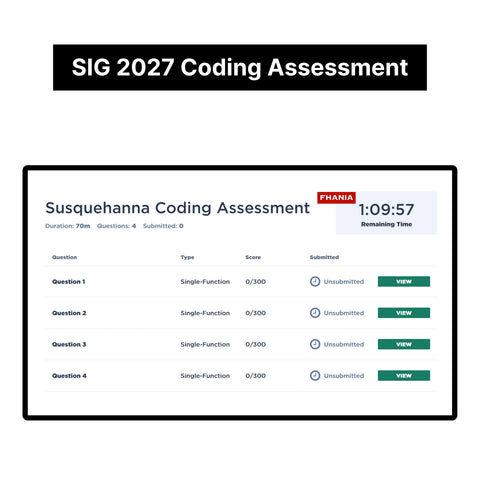
Our 2027 SIG Susquehanna Online Problem Solving | Coding Assessment Tutorials cover the exact probability, game theory, and interview questions SIG uses — with answers and reasoning walkthroughs, so the poker rounds feel like review.
They Hire People Who Already Think in Bets
The SIG trading interview poker and game theory questions aren't testing whether you can learn this thinking — they're testing whether you already do it. Every offer-holder walked into those rooms fluent in EV, equities, and equilibrium. Every rejected candidate was still converting gut feeling into math while the interviewer watched. The gap closes with deliberate practice, not talent. Start closing it now.
FAQ
Do I need to be good at poker for the SIG trading interview? You need poker decision-making (equities, EV, bet sizing), not tournament skill. The concepts transfer directly to trading.
What poker questions does SIG ask in interviews? Hand equity estimates, bet-sizing decisions, bluffing logic, and game theory translations like dice betting games.
How do I practice game theory for SIG interviews? Drill EV calculations, pot-odds problems, and simplified equilibrium games daily; do mock interviews with pushback.
Does the poker culture matter for non-trader roles? SWE and research candidates face lighter versions, but the poker culture still shows up in behavioral rounds.
Preparing for SIG Susquehanna's trading game? Our 2027 SIG Susquehanna Online Problem Solving | Coding Assessment Tutorials has the exact questions and answers — $79 one-time, instant download.