SIG Software Engineer Interview Process 2027
The SIG software engineer interview process for the 2027 intake runs: application, CodeSignal coding assessment, technical phone screens, and final onsite rounds covering algorithms and system design. It's a top-tier market maker's engineering bar — the CodeSignal round alone eliminates most applicants before any human sees them.
What the SWE Process Looks Like
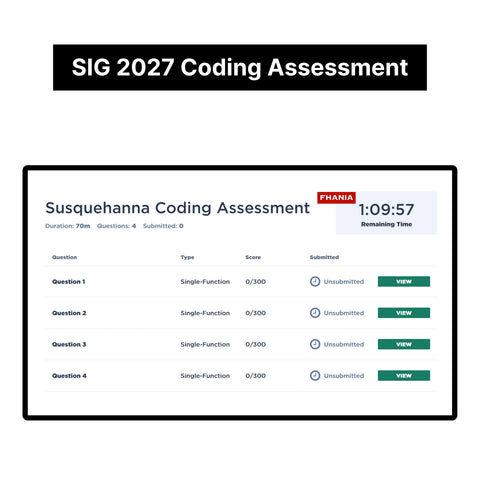
The SIG software engineer interview process follows a clear pipeline. First, the application and resume screen. Then the CodeSignal assessment — the same 4-question timed test (array operation, string manipulation, bouncing ball simulation, logic finisher) that filters the entire candidate pool. Survivors get technical phone interviews with live coding, and finalists attend onsite or virtual final rounds with deeper algorithms, system design, and behavioral conversations about SIG's engineering culture.
What Each Stage Assesses
- CodeSignal assessment: Raw coding fluency and algorithmic problem-solving under time pressure. This is the mass filter — most rejections happen here.
- Technical phone screens: Live coding with an engineer watching. Assesses communication, approach, and whether you can think while someone probes your reasoning.
- Final rounds: Harder algorithms, data structure depth, and system design for low-latency trading systems. Assesses whether you can build at SIG's scale and speed.
- Behavioral: Interest in markets, poker/game culture fit, and why a market maker over big tech.
How to Prepare as a SWE Candidate
The SIG software engineer interview process rewards candidates who front-load preparation on the filter that matters most.
- Conquer CodeSignal first. It's the gatekeeper. Drill the exact 4-question pattern — especially the Q3 bouncing ball simulation — until the whole test is routine.
- Practice live coding out loud. Phone screens punish silent solvers. Narrate your approach, complexity analysis, and trade-offs as you code.
- Study low-latency system design. SIG cares about performance: caching, concurrency, and efficient data structures in trading contexts.
Our 2027 SIG Susquehanna Online Problem Solving | Coding Assessment Tutorials contain the exact CodeSignal questions SIG uses for software engineer candidates, with answers and walkthroughs — the single highest-leverage preparation for the stage that rejects the most people.
The Bar Is the Filter, Not the Final
Most SWE candidates obsess over the final onsite and neglect the SIG software engineer interview process's real killer: the CodeSignal screen that runs before any engineer ever looks at you. You can be a brilliant system designer and still never get the chance to prove it, because an unprepared Q3 ended your run at stage one. The candidates who reach the final rounds are the ones who treated the automated test as seriously as the onsite. Pass the filter first; everything else follows.
FAQ
What is the SIG software engineer interview process? Application → CodeSignal assessment → technical phone screens → final rounds (algorithms, system design, behavioral).
How hard is the SIG CodeSignal for SWE candidates? Very — the same 4-question test as other tracks, with a high cutoff. The bouncing ball Q3 is the deciding question.
Does SIG SWE interview include system design? Final rounds can include system design with a low-latency trading focus, alongside advanced algorithms.
What languages can I use in SIG SWE interviews? Python, C++, and Java are standard on CodeSignal and in live rounds. C++ is popular given the low-latency domain.
Preparing for SIG Susquehanna's coding assessment? Our 2027 SIG Susquehanna Online Problem Solving | Coding Assessment Tutorials has the exact questions and answers — $79 one-time, instant download.