

SIG Rejection Reasons: Why Candidates Fail the OA
Most SIG rejections happen at the OA — the online assessment eliminates the large majority of applicants before any human interview. For the 2027 intake, the failure patterns are consistent: unprepared Q3, time mismanagement, weak-section exposure, and treating the test as a formality. Every one of these is preventable.
The Four Ways Candidates Fail the SIG OA
1. Meeting Q3 for the first time. The CodeSignal bouncing ball simulation is the single biggest rejection driver. Candidates who've never seen a grid simulation burn 25+ minutes on it and never recover. This alone accounts for a huge share of failures.
2. Time mismanagement. Spending 15 minutes perfecting Q1, then discovering Q3 needs 20 you don't have. The OA's single continuous clock punishes comfortable pacing on easy questions with catastrophic failure on hard ones.
3. A weak problem solving section. Trader-track candidates who code well but never drilled pattern recognition or timed combinatorics get cut on the problem solving test — the section they assumed their math background covered.
4. Treating it as a warm-up. Candidates who open the OA "to see what it's like" waste their one attempt. There are no retakes, and a failed OA is a closed door until next year.
What the Failures Have in Common
Every SIG OA rejection reason traces back to one root cause: novelty. Candidates fail questions they haven't seen, mismanage time on a format they haven't rehearsed, and discover the difficulty curve during the scored attempt. The OA doesn't primarily test ability — it tests preparation.
How to Avoid All Four
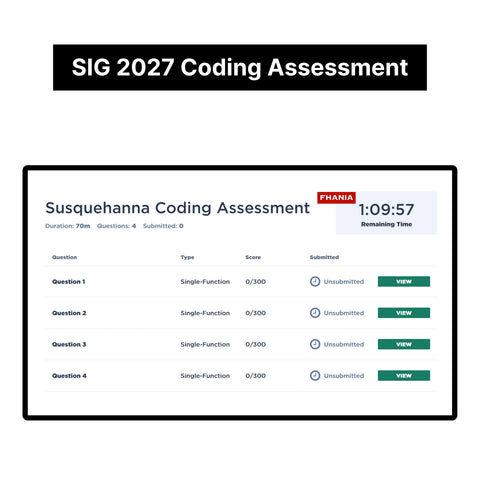
- Rehearse the exact questions. The CodeSignal 4-question lineup and the problem solving patterns are known. Drill them timed until nothing is new.
- Lock a time budget. 5/10/20 minutes for Q1-Q3 with a move-on rule. Practice full runs, not isolated questions.
- Fix your weak section first. Diagnose with a timed mixed set, then train the weakest axis hardest.
- Don't open the link until you're ready. The OA arrives days after applying — prepare before you apply.
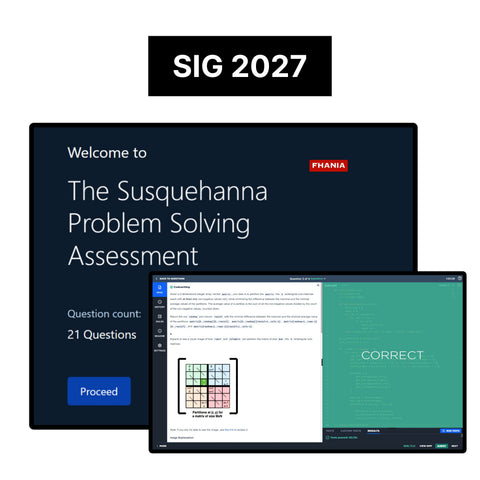
Our 2027 SIG Susquehanna Online Problem Solving | Coding Assessment Tutorials eliminate the novelty problem: the exact CodeSignal questions, problem solving patterns, and interview questions with answers — everything rejected candidates wish they'd seen beforehand.
The OA Doesn't Forgive — So Don't Need Forgiveness
The SIG OA rejects most candidates for entirely preventable reasons: an unseen Q3, a blown time budget, an undrilled weak section, a casual first attempt — all preparation, not ceiling. This cycle's advancers treated the test as the real filter and prepared for the actual questions. Do the same and the OA becomes a formality. Don't, and you become a statistic.
FAQ
What is the most common reason candidates fail the SIG OA? The Q3 bouncing ball simulation — encountered unprepared, it consumes the time budget and sinks the test.
Can I retake the SIG OA if I fail? No — one attempt per cycle. A failed OA closes the door until the next intake.
Is the CodeSignal or problem solving section failed more often? CodeSignal Q3 is the single biggest filter; the problem solving test cuts candidates with undrilled weak sections.
How do I know I'm ready for the SIG OA? When full timed runs on the real question patterns fit the budget, with Q3 solved confidently.
Preparing for SIG Susquehanna's coding assessment? Our 2027 SIG Susquehanna Online Problem Solving | Coding Assessment Tutorials has the exact questions and answers — $79 one-time, instant download.