SIG Quantitative Trader Interview: OA to Discovery Day
The SIG quantitative trader interview path for 2027 runs: online assessment (problem solving + CodeSignal), phone math interview, further technical rounds, and Discovery Day. It's a double filter — you must clear both the probability/logic tests and the coding test before ever meeting a trader. Each stage eliminates candidates who are strong in only one dimension.
What the Quant Trader Path Looks Like
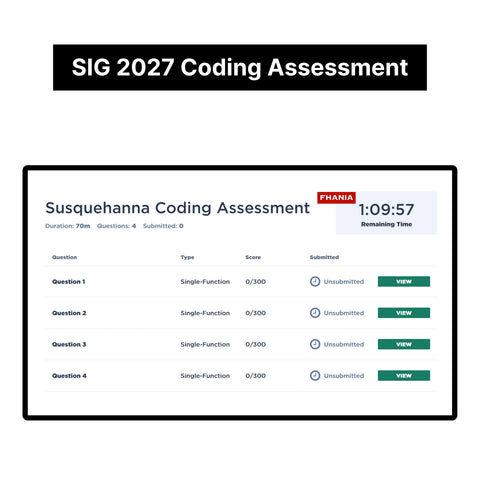
SIG's quantitative trader interview process starts with the online assessment: the problem solving test (logic, numerical reasoning, probability/combinatorics) and the CodeSignal coding assessment (4 timed questions including the bouncing ball simulation). Pass both and you reach the phone interview with mental math and probability questions, narrated live. Later rounds deepen the probability and game theory, and the process culminates in Discovery Day's trading games and final interviews.
What Each Stage Assesses
- Problem solving OA: Mathematical and logical fluency — the quant core. Probability and combinatorics are the deciding sections.
- CodeSignal OA: Implementation ability. SIG's quants code; candidates who can't translate math into programs don't survive.
- Phone math interview: Live mental math and EV questions with verbal narration. Assesses speed, clarity, and composure.
- Technical rounds + Discovery Day: Game theory, trading games, markets discussion. Assesses whether you think like a trader, not just compute like one.
How to Prepare for the Full Path
The SIG quantitative trader interview punishes single-dimension preparation. Your plan must cover both axes from day one.
- Parallel-track math and code. Alternate days between probability/combinatorics drills and timed CodeSignal practice. Neglecting either fails you at its stage.
- Rehearse the exact questions. Both OAs reuse known patterns — the combinatorics families and the 4 CodeSignal questions. Familiarity is the highest-ROI preparation there is.
- Mock the interactive rounds early. Phone math narration and trading games need live practice partners, not solo study.
Our 2027 SIG Susquehanna Online Problem Solving | Coding Assessment Tutorials cover both halves of the quant trader filter — the exact problem solving questions (probability, logic, numerical) and the exact CodeSignal questions — with answers and walkthroughs for the full path from OA to Discovery Day.
One-Dimensional Candidates Don't Survive
The SIG quantitative trader interview is designed to reject brilliant mathematicians who can't code and brilliant coders who can't do probability under pressure. Every cycle, candidates who aced one OA get cut at the next. The offer-holders are the ones who prepared for the whole pipeline as one continuous test. If you're only training your strong half, you're training for rejection. Cover both — starting now.
FAQ
What is the SIG quantitative trader interview process? OA (problem solving + CodeSignal) → phone math interview → technical rounds → Discovery Day.
Do quant traders need to code at SIG? Yes — the CodeSignal assessment is required, and SIG quants write production-adjacent code.
Which OA stage is harder for quant trader candidates? It depends on your background: math-strong candidates struggle with Q3's simulation; CS-strong candidates struggle with timed combinatorics.
How long does the SIG quant trader process take? Typically several weeks from OA to Discovery Day. Check SIG's official careers page for the 2027 intake timeline.
Preparing for SIG Susquehanna's problem solving? Our 2027 SIG Susquehanna Online Problem Solving | Coding Assessment Tutorials has the exact questions and answers — $79 one-time, instant download.