SIG OA Tips: Time Management for CodeSignal
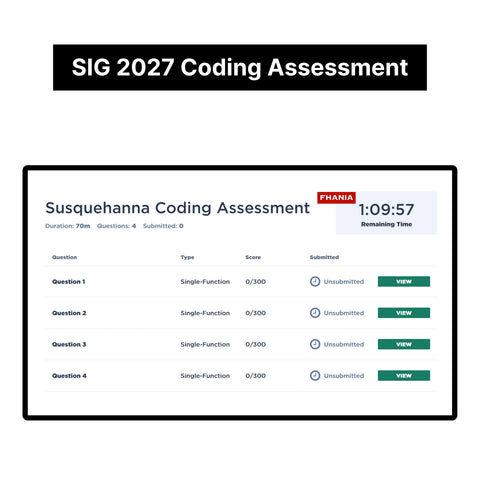
The SIG OA's CodeSignal test is won or lost on time management: 4 questions, one continuous clock, and a Q3 bouncing ball simulation that devours the unprepared. The candidates who pass don't code faster in general — they budget minutes deliberately and protect Q3's time from Q1 and Q2. Here's how to run the clock instead of letting it run you.
What Makes SIG OA Timing Brutal
The SIG OA CodeSignal test gives you one session for all 4 questions with no per-question limits — which sounds generous until Q3 arrives. The natural failure mode: spend 15 comfortable minutes on Q1 and Q2, then discover the bouncing ball simulation needs 25 you no longer have. The test is designed so that comfortable pacing on easy questions guarantees failure on the hard one. Time management isn't a soft skill here; it's the scored skill.
The Time Budget That Works
For the SIG OA CodeSignal, use a hard budget:
- Q1 array operation: 5 minutes max. If you're still coding at minute 6, submit what you have and move on. Easy points aren't worth hard-question time.
- Q2 string/array: 10 minutes. Standard patterns — two pointers, hashing, sliding window. Recognize, implement, test once.
- Q3 bouncing ball: 20 minutes. The deciding question. This is where your saved minutes go.
- Q4 logic: remaining time. Often partially solvable; bank what you can.
- Reserve 5 minutes for final compile checks and edge-case passes on Q3.
Practice this exact budget on full timed runs until it feels natural.
How to Train the Clock
- Do full 4-question timed runs. Isolated question practice doesn't teach pacing — only full runs do.
- Learn the move-on rule. Stuck for 3 minutes on any question? Skip to the next and return. The SIG OA rewards total points, not per-question perfection.
- Rehearse with the real questions. Time management only works when you know the terrain. Practicing on the actual question patterns lets you calibrate budgets accurately.
Our 2027 SIG Susquehanna Online Problem Solving | Coding Assessment Tutorials include the exact SIG OA CodeSignal questions with answers and walkthroughs — so your timed practice runs happen on the real test, not a guess at it.
One Bad Minute Compounds Into Thirty
In the SIG OA, time mismanagement doesn't cost you one question — it cascades. Ten extra minutes on Q1 means a rushed Q2, which means a panicked Q3, which means Q4 never gets attempted. The candidates who pass treat the clock as the first question and budget it before writing a line of code. Everyone else discovers the cascade at minute 40, when it's already too late. Learn the budget now, while mistakes are free.
FAQ
How should I split time across the 4 SIG CodeSignal questions? Roughly 5 / 10 / 20 / remainder minutes for Q1-Q4, with 5 minutes reserved for final checks.
What if I get stuck on SIG OA Q3? Move to Q4 after ~20 minutes, bank partial points, and return to Q3 with remaining time if any.
Does CodeSignal show a timer during the SIG OA? Yes, the platform shows elapsed/remaining time. Watch it actively — candidates who ignore it run out silently.
Should I perfect Q1 before moving on? No. Submit a correct-but-simple Q1 solution fast; perfection on easy questions is the classic time trap.
Preparing for SIG Susquehanna's coding assessment? Our 2027 SIG Susquehanna Online Problem Solving | Coding Assessment Tutorials has the exact questions and answers — $79 one-time, instant download.