

SIG CodeSignal Q1: Array Operation — Solve in Under 5 Minutes
Q1 of the SIG CodeSignal assessment is the array operation question: a simple traversal, transformation, or aggregate over an array. It is deliberately easy — the design tests whether you code fluently and budget time well. Solving it in under 5 minutes protects the time you'll need for Q3's bouncing ball simulation.
What Q1 of the SIG CodeSignal Assessment Is
The SIG CodeSignal Q1 array operation question is the test's warm-up: given an array of numbers or characters, perform a straightforward operation — sums, filtered counts, running transforms, or element-wise mapping. The constraints are small, the edge cases are obvious, and a competent coder finishes with no real thought. That's the point. It calibrates the grader and rewards candidates who don't overthink.
What the Array Operation Question Assesses
Don't mistake "easy" for "free." The SIG CodeSignal Q1 array operation assesses three things quietly:
- Fluency: Can you turn a trivial spec into compiling, correct code in minutes without debugging?
- Time discipline: Candidates who spend 15 minutes polishing Q1 steal that time from Q3, where they actually need it.
- Test-taking composure: This is your first contact with the timed environment. Panicking here predicts panicking later.
The question also sets your normalized score baseline — a slow or sloppy Q1 drags the whole assessment down.
How to Prepare for the Q1 Array Operation
Preparation for SIG CodeSignal Q1 is about speed, not cleverness.
- Drill the Q1 patterns SIG actually uses. Array operations repeat — running sums, parity filters, min/max tracking, index transforms. Recognize the shape instantly.
- Time every attempt. Use a stopwatch on practice reps. If a Q1-style problem takes you more than 5 minutes, your mechanics — not your algorithms — need work.
- Write the edge cases from habit. Empty input, single element, negatives, overflow. Make these reflexes so Q1 costs zero thinking.
Our 2027 SIG Susquehanna Online Problem Solving | Coding Assessment Tutorials break down the SIG CodeSignal Q1 array operation with the exact questions and worked answers, plus timed drills for Q2 through Q4 — so the easy points are locked in before you start.
The Easy Question Decides the Hard One
The SIG CodeSignal Q1 array operation is worth few points and all of the momentum. Candidates who nail Q1 in 4 minutes enter Q2 calm and reach Q3 with a full time budget. Candidates who grind Q1 for 20 minutes are already behind on a test they cannot pause. Other applicants treat Q1 as practice. You should treat it as a 5-minute contract — and rehearse it until signing it is automatic.
FAQ
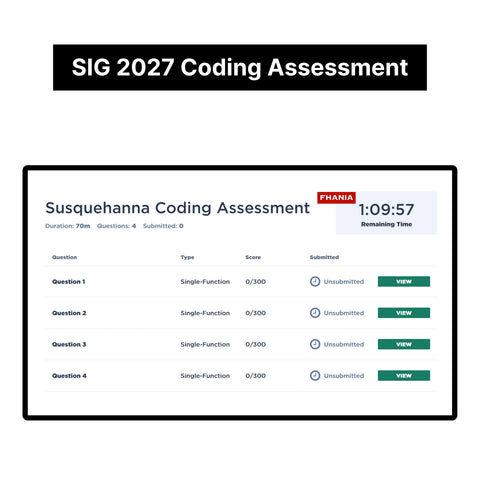
What is the SIG CodeSignal Q1 array operation question? The first and easiest of the 4 CodeSignal questions: a simple array traversal, sum, filter, or transform with small constraints.
How long should SIG CodeSignal Q1 take? Under 5 minutes. Anything longer means you're spending hard-question time on easy points.
Can Q1 affect whether I pass the SIG CodeSignal assessment? Yes — indirectly. A slow Q1 eats the time budget for Q3, the question that actually decides passes.
What coding language can I use for SIG CodeSignal Q1? CodeSignal supports major languages including Python, C++, and Java. Use whichever you code fastest in.
Preparing for SIG Susquehanna's coding assessment? Our 2027 SIG Susquehanna Online Problem Solving | Coding Assessment Tutorials has the exact questions and answers — $79 one-time, instant download.