SIG CodeSignal Assessment: 4 Questions Breakdown 2027
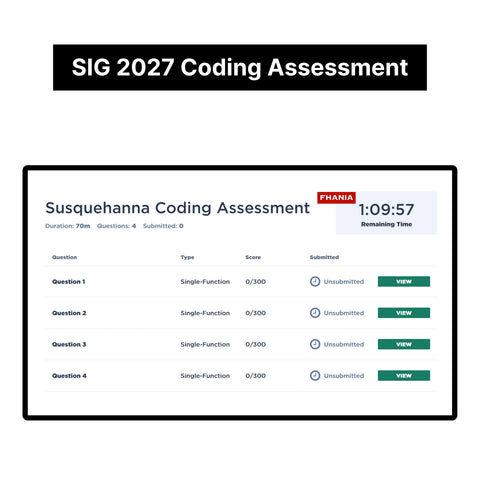
SIG's CodeSignal assessment for the 2027 intake is a timed coding test with exactly 4 questions, increasing in difficulty. The standard lineup is Q1 array operation (warm-up), Q2 string/array manipulation, Q3 bouncing ball grid simulation (the hardest), and Q4 a logic-heavy finisher. You get one shot per question, and the clock never stops.
What the SIG CodeSignal Assessment Is
After you submit your application to SIG's 2027 intake, selected candidates receive a CodeSignal link within days. The SIG CodeSignal assessment is the first real filter in the hiring process — it runs on the CodeSignal platform, is fully automated, and your score is reported to recruiters as a normalized number. There is no human review at this stage; fall below the cutoff and your application ends here, regardless of your resume.
What the 4 Questions Assess
Each question in the SIG CodeSignal assessment targets a different layer of ability:
- Q1 — Array operation: Simple traversals, sums, or transforms. Tests whether you can code fluently under zero pressure.
- Q2 — String/array manipulation: Two pointers, hashing, or sliding windows. Tests core algorithmic competence.
- Q3 — Bouncing ball grid simulation: A ball reflects off grid boundaries and obstacles. Tests state simulation, edge cases, and debugging under time pressure. Most candidates lose their pass here.
- Q4 — Logic finisher: Combinatorial or mathematical reasoning coded from scratch — tests whether you can translate math into code.
How to Prepare for the SIG CodeSignal Assessment
Generic LeetCode practice helps, but the SIG CodeSignal assessment punishes unprepared candidates in a specific way: the time budget collapses if Q3 surprises you. The candidates who pass walk in knowing the exact question patterns.
Preparation that works:
- Solve each known question against a timer — one attempt, no pausing.
- Drill Q3 until it's boring. The bouncing ball simulation has standard state-transition patterns. If you've seen them, it's a 10-minute question. If not, it's a timeout.
- Build a Q1 speed habit. Q1 should take under 5 minutes. Every minute stolen from Q1 and Q2 is time Q3 doesn't get.
Our 2027 SIG Susquehanna Online Problem Solving | Coding Assessment Tutorials cover the exact CodeSignal question patterns SIG uses — array operation, string manipulation, the bouncing ball grid simulation, and the logic finisher — with answers and walkthroughs so nothing in the test is new to you.
Don't Learn About Q3 During Q3
The SIG CodeSignal assessment is one session with no retakes. Candidates who meet the bouncing ball for the first time inside the test almost always run out of time. Everyone competing for your spot already knows the 4-question lineup — the only question is whether you've practiced them before the clock starts.
FAQ
How many questions are in the SIG CodeSignal assessment? Four questions of increasing difficulty: array operation, string/array manipulation, bouncing ball simulation, and a logic finisher.
How long do I have for the SIG CodeSignal assessment? One timed session on the CodeSignal platform — budget roughly 5-10-20 minutes per question with debugging buffer.
What score do I need to pass the SIG CodeSignal assessment? SIG doesn't publish the cutoff — a top-tier normalized score is expected, and partial Q3/Q4 solutions rarely clear it.
Can I retake the SIG CodeSignal assessment if I fail? No — one attempt per cycle, so prepare before you open the link.
Preparing for SIG Susquehanna's coding assessment? Our 2027 SIG Susquehanna Online Problem Solving | Coding Assessment Tutorials has the exact questions and answers — $79 one-time, instant download.