

Shell VJT vs HireVue 2027: How Shell's Process Differs
Candidates often ask about Shell VJT vs HireVue — and the confusion is costly. Shell's Virtual Job Tryout is a SHL-built gamified assessment, not a HireVue interview, and preparing for the Shell VJT vs HireVue mix-up with HireVue tactics means training for the wrong test entirely.
What Each One Actually Is
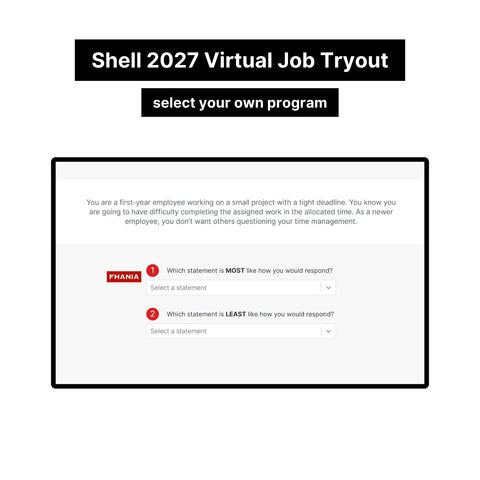
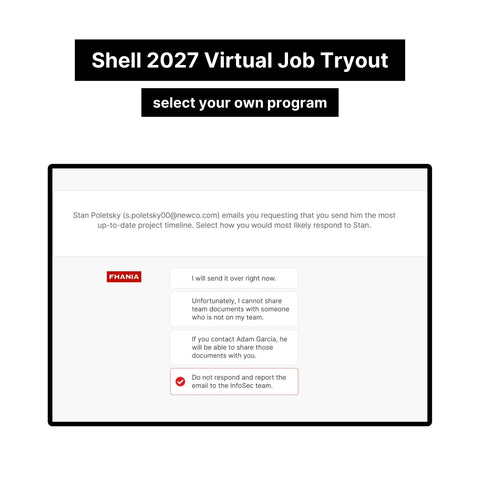
Shell VJT: A gamified SHL-built assessment combining work-challenge scenarios, work-style pairs, reasoning tasks, and logic games in roughly 30 minutes. No video, no interviewer, no speaking. It measures judgement, working style, and reasoning.
HireVue: A video-interview platform used by many employers for one-way recorded interviews. When candidates say "HireVue," they usually mean that format: questions on screen, timed recorded answers.
Shell's 2027 process uses the VJT followed by a separate on-demand video interview — video-interview-like, but the VJT itself is not HireVue.
Shell VJT vs HireVue: Key Differences
- Format. VJT: interactive games and scenarios you click through. HireVue-style interviews: you on camera, speaking.
- What is scored. VJT: judgement against Shell's values, consistency of work style, reasoning speed and accuracy. Video interviews: communication, motivation, competency evidence (STAR stories).
- Preparation. VJT prep: scenario scoring logic, timed reasoning drills, work-style consistency. Video interview prep: story bank, delivery, camera presence.
- Failure modes. VJT: unfamiliarity with formats, time mismanagement, values misalignment. Video interviews: rambling, weak motivation narrative, poor delivery.
- Faking risk. The VJT's cross-checking pairs catch manufactured personalities; video interviews catch memorised scripts through delivery.
Why the Confusion Hurts Candidates
The Shell VJT vs HireVue mix-up leads candidates to prepare for the wrong skills: rehearsing STAR stories for a test with no speaking, or drilling reasoning puzzles for an interview needing motivation narratives. Worse, some treat "game-based" as casual and play the VJT like a phone game — the fastest route to failure. Each stage demands its own preparation.
How to Prepare for Each Correctly
- For the VJT: Learn the scenario scoring logic (safety first, communicate, evidence over gut), drill timed reasoning, and answer work-style pairs honestly and consistently.
- For the on-demand video interview: Build 6–8 STAR stories, craft a specific 'Why Shell?' narrative tied to the energy transition, and rehearse on camera.
- Sequence your prep. The VJT comes first and its invitation can arrive within days of applying — prepare for it before you apply, then shift to interview prep while awaiting results.
- Use stage-specific material. Generic prep that ignores the VJT/video-interview distinction trains neither properly.
Our 2027 Shell Virtual Job Tryout and On-demand Interview Tutorials cover both stages distinctly: the VJT's exact question types with scoring logic and timed practice, plus the full on-demand interview question bank with model answers.
Wrong Test, Wrong Prep, No Offer
This is the quietest way to fail: diligent preparation aimed at the wrong target. The candidates who pass prepared for the right test. Know which stage you are facing, and do not let a platform-name confusion choose your strategy.
FAQ
Does Shell use HireVue for the VJT? No. The Virtual Job Tryout is a SHL-built gamified assessment. Shell uses a separate on-demand video interview after the VJT.
Is the Shell on-demand interview like HireVue? It shares the one-way recorded format, so video-interview preparation techniques (STAR, camera presence) apply there — but not to the VJT.
Which should I prepare for first? The VJT, because it comes first in the 2027 process and invitations arrive quickly after application screening.
Preparing for Shell's VJT vs HireVue? Our 2027 Shell Virtual Job Tryout and On-demand Interview Tutorials has the exact questions and answers — $79 one-time, instant download.