Scotiabank Plum: Problem-Solving Games Explained
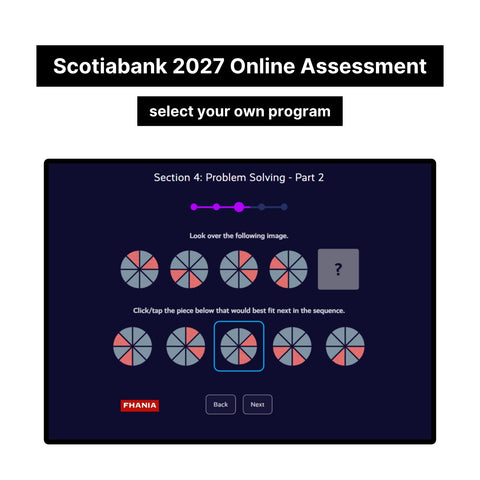
The Scotiabank Plum problem-solving games are timed logic puzzles — pattern recognition, sequencing, and spatial reasoning — that open the assessment for 2027 intake. They measure how quickly and accurately you think under pressure, and they are the single most practice-sensitive section of the whole test.
What the Scotiabank Plum Problem-Solving Games Look Like
Expect a series of short puzzles, each with a tight timer: complete the pattern, find the next item in a sequence, identify the rule linking shapes or numbers. The rules are simple to grasp — that's the point — but the clock is unforgiving, and difficulty ramps as you progress. Each game feeds talents like problem solving, execution, and innovation in your Plum profile. Most candidates finish feeling they could have done better with more time, which is exactly what the games are designed to reveal.
What Scotiabank Plum Problem Solving Assesses
Raw cognitive horsepower under realistic pressure: can you spot structure fast, hold it in working memory, and execute without errors while the timer runs? In banking and technology roles, this mirrors the job — markets, clients, and systems don't wait for you to feel ready. The games also assess composure: candidates who panic on a hard puzzle and spiral into the next ones score far below their true ability. Speed matters, but accuracy matters more; wrong fast answers are the worst combination.
How to Prepare for the Scotiabank Plum Problem-Solving Games
Do timed puzzle practice daily for one to two weeks — pattern matrices, number sequences, and logic grids — and track both your speed and your error rate. Learn the common puzzle archetypes so you recognize structures instantly instead of deriving them from scratch. Practice recovering from a blown puzzle: skip, breathe, and attack the next one, because dwelling destroys the rest of the section. Most importantly, rehearse the actual format with our 2027 Scotiabank Plum Assessment and Digital Interview Exact Questions and Answers, which includes the exact Plum questions and answers — familiarity with the real games is worth more than a hundred generic puzzles.
Why Speed Plus Steadiness Wins
The games reward the candidate who is both fast and unflappable — quick pattern recognition with zero panic spirals. Brilliant candidates who never practiced under a timer leave points everywhere; average candidates who drilled daily walk out with top-quartile game scores. This section doesn't measure your intelligence ceiling. It measures your trained performance, and trained performance is a choice.
Frequently Asked Questions
What kinds of puzzles are in the Plum problem-solving games? Pattern recognition, sequencing, and logic puzzles with tight per-question timers.
Are the Plum games like an IQ test? They measure similar abilities, but they're designed around trainable skills — practice genuinely improves scores.
How much do the games affect my match score? Significantly — they feed multiple talents and are the most score-sensitive section of the assessment.
Should I guess or skip hard puzzles? Don't dwell: make your best quick attempt and move on. Time spent stuck is points lost elsewhere.
Preparing for Scotiabank's Plum assessment? Our 2027 Scotiabank Plum Assessment and Digital Interview Exact Questions and Answers has the exact questions and answers — $79 one-time, instant download.