PI Numerical Reasoning: Number Series & Comparisons Explained
PI numerical reasoning is the math section of the Predictive Index Cognitive test — roughly a third of the 50 questions. It covers number series (find the next number), numerical comparisons (which value is larger), and arithmetic word problems. You get no calculator, and the questions are deliberately dense: simple math, but packed tight and timed brutally.
What PI Numerical Reasoning Looks Like
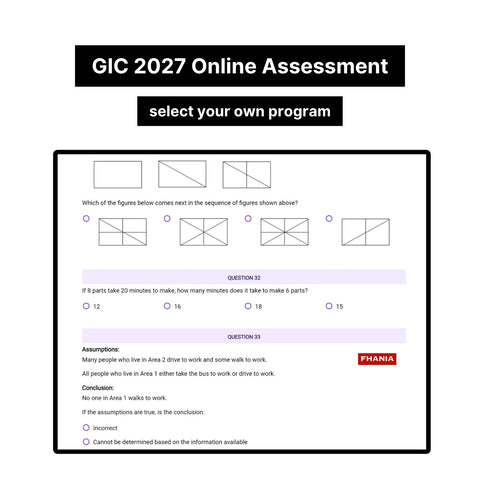
A typical PI numerical reasoning question shows you a series like 4, 9, 16, 25, __ and asks for the next value (36 — they are squares plus offsets, or in this case perfect squares 2², 3², 4², 5²). Comparisons give you two columns and ask which side is larger or if they are equal. Word problems are short practical scenarios — percentages, ratios, simple interest, unit conversions. None of this is hard math. The difficulty is volume: you must recognize patterns instantly or you will not finish.
What Predictive Index Numerical Reasoning Assesses
The predictive index numerical reasoning section tests how quickly you extract structure from numbers under pressure. GIC uses it because fund management roles demand fast quantitative judgment. The test does not care whether you can do the math — it assumes you can. It measures whether you can do it at speed, pick the right operation on the first read, and stay accurate while the clock runs down. Sloppy arithmetic and second-guessing are what actually sink scores.
How to Prepare for Predictive Index Numerical Reasoning
Memorize the common series patterns: arithmetic progressions, geometric multiples, alternating operations, squares, cubes, prime sequences, and Fibonacci-style additions. Drill comparison questions until spotting the larger side takes three seconds. For word problems, practice translating text to an equation on the first read — slow reading is where candidates bleed time. Our 2027 GIC Learning Indicator PI Cognitive Assessment Exact Questions & Answers includes the exact numerical formats that appear on the GIC PI — series, comparisons, and word problems with worked answers.
Here is the FOMO reality: the numerical questions are the densest on the test, and slow calculators simply run out of time. Every unanswered question is a zero. Candidates who drill patterns finish the section; candidates who "just do math" leave points on the table. The test rewards preparation, not talent.
FAQ
Is a calculator allowed on the PI numerical reasoning test? No. All calculation is mental math, which is why pattern recognition and speed matter so much.
How many numerical questions are on the PI cognitive test? The 50 questions are mixed across numerical, verbal, and abstract types — expect roughly a third to be numerical, but the exact split varies.
What math level is the PI numerical reasoning? High-school level: percentages, ratios, basic algebra, series. The challenge is speed, not difficulty.
Should I guess on numerical questions I'm stuck on? If a question takes more than 20 seconds, skip it and come back. There is no penalty for wrong answers, so answer everything if you reach the end.
Preparing for GIC's PI Cognitive assessment? Our 2027 GIC Learning Indicator PI Cognitive Assessment Exact Questions & Answers has the exact questions and answers — $79 one-time, instant download.