PI Behavioral Assessment: Adjective Selection Guide
The PI behavioral assessment is the untimed companion to the PI cognitive test: you are shown lists of adjectives and asked to select the ones that describe you, then the ones you believe others expect you to be at work. It takes 5–10 minutes, has no right answers, and is where candidates get eliminated by trying to game it.
What the PI Behavioral Assessment Is
The predictive index behavioral assessment presents you with a list of about 86 adjectives — words like "decisive," "patient," "sociable," "precise." You go through it twice: first selecting words that describe how you see yourself, then selecting words that describe how you think the job expects you to behave. Your selections map onto four behavioral drives: Dominance (need for control and influence), Extraversion (need for social interaction), Patience (need for stability and consistency), and Formality (need for structure and rules). The result is a behavioral profile, not a score.
What the Predictive Index Behavioral Assessment Assesses
The predictive index behavioral assessment is compared against a "job target" — the behavioral profile GIC defines as ideal for the role. A trading-floor role may target high Dominance and low Patience; a research role may target high Formality. The danger is not answering "wrong" — it is answering inconsistently. If your self-description says "spontaneous" but your expected-behavior list says "methodical," the system flags the mismatch. GIC is screening for behavioral fit and reliability, and obvious gaming attempts show up as contradictions between the two rounds.
How to Prepare for the PI Behavioral Assessment
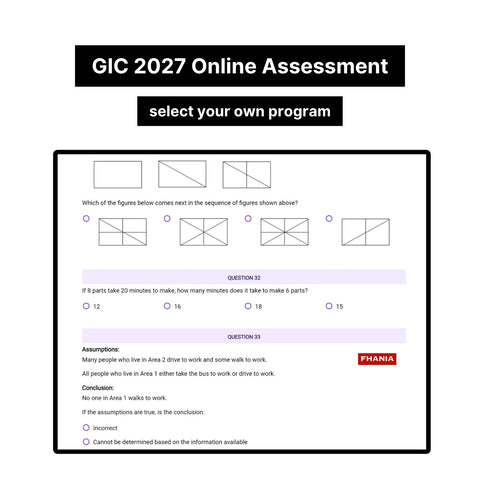
Do not try to reverse-engineer the "ideal" profile — you cannot know GIC's exact job target, and faking it produces inconsistencies that look worse than a genuine mismatch. Instead: answer honestly but with the role in mind, keep your two rounds consistent (the words that truly describe you should largely overlap with what the role needs), and avoid selecting contradictory adjectives. Think about real examples from your experience that back up your selections — if GIC interviews you, your stories should match your profile. Our 2027 GIC Learning Indicator PI Cognitive Assessment Exact Questions & Answers walks through the exact behavioral format and the four-drive framework so you understand what your selections signal before test day.
Here is the FOMO truth: candidates obsess over the cognitive test and treat the behavioral half as a formality — then get screened out by contradictions they created themselves. The two rounds are compared against each other. Pick words that are true and consistent, and you pass. Try to outsmart it, and you fail at the easiest part of the process.
FAQ
How long does the PI behavioral assessment take? It is untimed and typically takes 5–10 minutes.
Can you fail the PI behavioral assessment? There is no pass/fail score, but your profile is matched against the role's job target — a poor fit can lead to rejection.
Should I pick adjectives that match the job description? Partially. Role-awareness is fine, but your two rounds must stay consistent with each other. Contradictions are the real red flag.
Does the behavioral assessment affect my cognitive score? No. They are scored separately — the cognitive test gives a score, the behavioral gives a profile. Both feed into the hiring decision.
Preparing for GIC's PI Cognitive assessment? Our 2027 GIC Learning Indicator PI Cognitive Assessment Exact Questions & Answers has the exact questions and answers — $79 one-time, instant download.