

PI Abstract Reasoning: Pattern Recognition Tips
PI abstract reasoning is the visual section of the Predictive Index Cognitive test: grids of shapes, symbols, and figures where you must spot the rule and pick what comes next. No numbers, no words — just patterns. It is the section where familiarity pays off most: known pattern types take ten seconds, unseen ones take a minute.
What PI Abstract Reasoning Looks Like
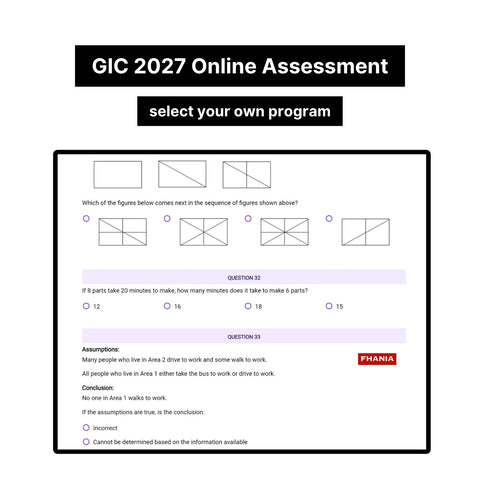
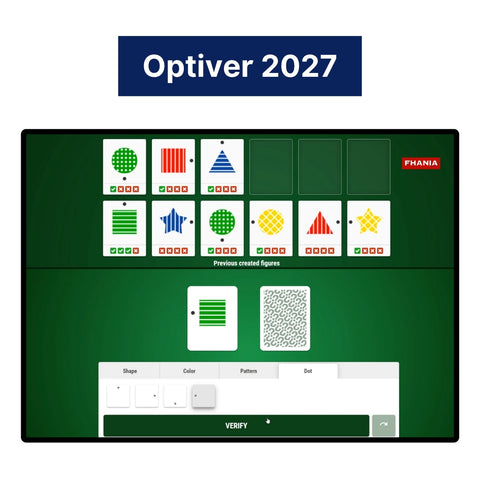
A PI abstract reasoning question shows a sequence or matrix of shapes — circles, arrows, lines, shaded boxes — and asks which option completes the pattern. The rules are always one of a small family: rotation, reflection, addition or subtraction of elements, alternation, progression of shading, or counting elements. For example, a shape might rotate 90 degrees each step while adding one dot, or a matrix might require the third column to be the combination of the first two. Once you know the vocabulary of transformations, most questions solve themselves.
What Predictive Index Abstract Reasoning Assesses
The predictive index abstract reasoning section measures fluid intelligence: your ability to detect structure in unfamiliar information without relying on learned knowledge. GIC values this because investment work constantly throws novel situations at you — new markets, new data, new risks. Unlike the verbal and numerical sections, you cannot compensate with vocabulary or arithmetic. The test isolates pure pattern processing speed. Candidates who have never practiced visual patterns burn enormous time on questions that practiced candidates answer on sight.
How to Prepare for Predictive Index Abstract Reasoning
Learn the transformation families by name: rotation, reflection, alternation, addition/subtraction, progression, and distribution. Then drill with a rule: scan for the simplest transformation first, then layer complexity. Always check rotation and alternation before trying exotic rules — the test favors simple patterns. Set a hard 20-second cap per question; abstract questions are the worst time sinks because staring longer rarely helps. Our 2027 GIC Learning Indicator PI Cognitive Assessment Exact Questions & Answers includes the exact visual pattern types that appear on GIC's PI, so every rule you will face is one you have already drilled.
Here is the FOMO truth: pattern questions reward the prepared and punish the curious. A practiced candidate finishes an abstract question in ten seconds flat. An unpracticed candidate spends a full minute reverse-engineering a rotation rule and still guesses. There are only so many pattern types — learn them all once, and this section becomes your fastest.
FAQ
How many abstract reasoning questions are on the PI? The 50 questions mix numerical, verbal, and abstract types — expect roughly a third to be visual patterns, though the exact split is not published.
Is abstract reasoning the hardest PI section? It is the most unfamiliar for most candidates, but it is also the most trainable — the pattern vocabulary is small and repeats.
What if I get stuck on a pattern question? Skip it immediately. Abstract questions are all-or-nothing: if you do not see the rule in 20 seconds, you probably will not see it in 60.
Do I need drawing skills for PI abstract reasoning? No. You only select the correct completion from options. All reasoning is visual recognition, not construction.
Preparing for GIC's PI Cognitive assessment? Our 2027 GIC Learning Indicator PI Cognitive Assessment Exact Questions & Answers has the exact questions and answers — $79 one-time, instant download.