NatWest Situational Judgement Test: 15 Questions Guide
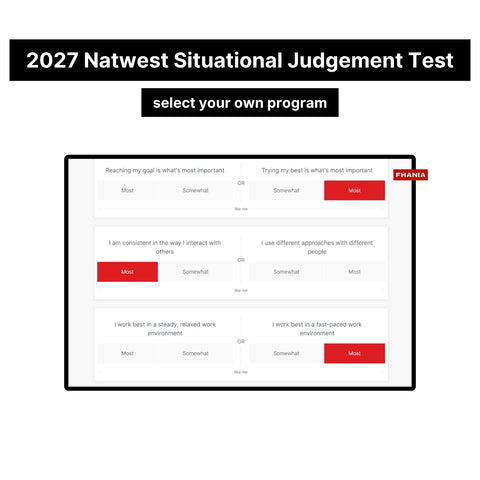
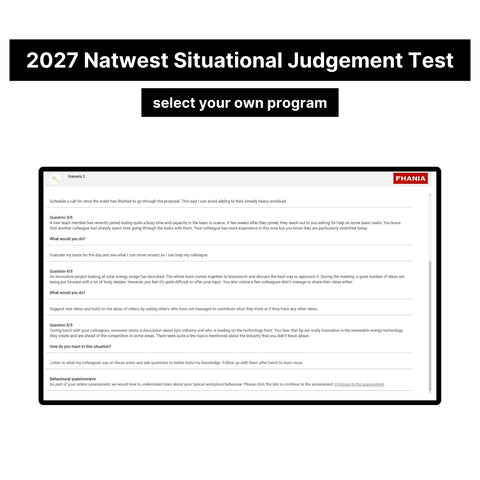
The NatWest situational judgement test presents around 15 workplace scenarios — usually with a tight timer of about 20 minutes — and asks you to choose the most and least effective responses. Each scenario mirrors real situations at a purpose-led bank: helping a struggling customer, flagging a risk, or handling a team conflict. There are no obviously "wrong" answers, but your choices reveal whether your instincts match NatWest's values.
What the NatWest Situational Judgement Test Is
NatWest uses the situational judgement test (SJT) as its first-round screen after the application. You read a short scenario, then rank or select responses from best to worst. The test is typically completed online in one sitting, and the format is consistent across graduate and internship programmes. Unlike reasoning tests, the SJT has no calculations — it measures judgement, and it is scored against the bank's own model of effective behaviour.
What the NatWest Situational Judgement Test Assesses
Every NatWest situational judgement test scenario is a values test in disguise. Assessors are looking for customer focus (do you put the customer's interest first?), integrity (do you speak up when something looks wrong?), and sound judgement under ambiguity. The trap answers look efficient but cut corners — for example, solving a customer's problem by bending a rule. NatWest wants to see that you balance commercial sense with doing the right thing, because that is the culture regulators expect from the bank.
How to Prepare for the NatWest Situational Judgement Test
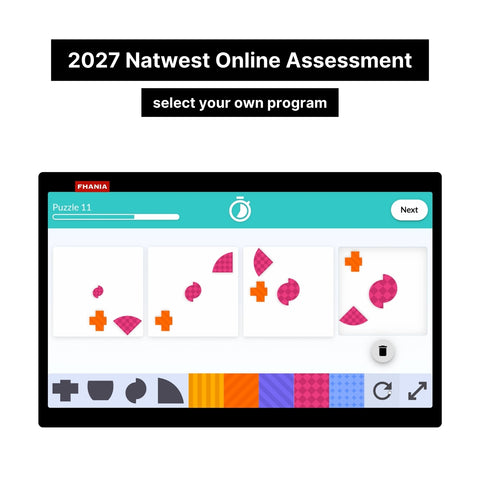
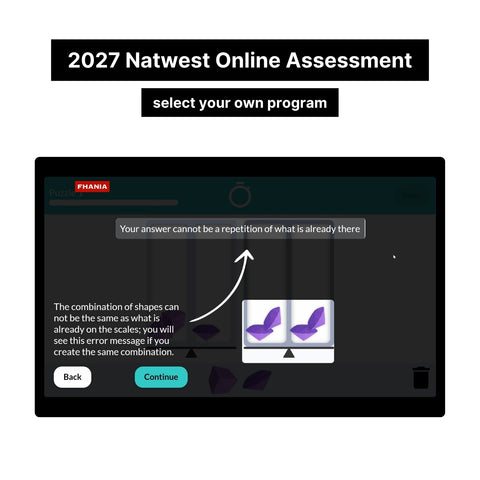
The best preparation is internalising NatWest's values before you see a single scenario. Read the bank's purpose statement and think about what "purpose-led" means in practice for frontline decisions. Then work through realistic scenarios and compare your instincts against model answers, so you learn the scoring logic instead of guessing. Our 2027 NatWest Group Online Assessment and Video Interview Tutorials include the full 2027 Round-1 work scenarios with answers that show exactly how NatWest expects you to respond to each situation.
Twenty Minutes, Fifteen Scenarios, One Wrong Value and You're Out
Here is what makes this test dangerous: it feels easy, so most candidates don't prepare. They answer on gut instinct, and gut instinct from a different industry — or no industry — gets flagged fast. The candidates who pass didn't get luckier scenarios; they knew what NatWest rewards before they clicked start. If your values compass points even slightly off the bank's, the SJT catches it. Fifteen scenarios is not a lot of room to recover.
FAQ
Is the NatWest situational judgement test timed? Yes. Expect roughly 20 minutes for the full set, which means just over a minute per scenario. Read fast and commit.
Should I answer honestly or strategically? Answer as the employee NatWest describes in its values — that is what the scoring model rewards. "Honest" answers that clash with the bank's culture score poorly.
Can I practice the SJT before taking it? Yes, and you should. Working through realistic scenarios with model answers is the fastest way to learn the scoring logic.
Does the SJT differ between programmes? The core format is the same, though scenarios may reference different business areas such as NatWest Markets or Commercial Banking. The values being tested don't change.
Preparing for NatWest's situational judgement test? Our 2027 NatWest Group Online Assessment and Video Interview Tutorials has the exact questions and answers — $79 one-time, instant download.