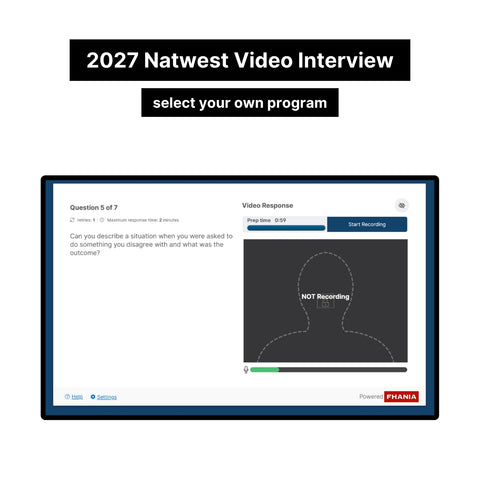
NatWest Interview 2027: 'Biggest Weakness' Answer Framework
For the NatWest biggest weakness question, use three parts: name a real weakness, show you understand its impact on others, and describe the concrete system you use to manage it. The management plan is the most important sentence. Commonly reported by candidates.
What This Question Assesses
This is a self-awareness and honesty test, not a trap. The interviewer wants to see whether you can evaluate yourself candidly, whether you take responsibility for your development, and whether your weakness would actually impair you in this role. Clichés ("I am a perfectionist") and disguised strengths signal evasiveness; a genuine weakness with a genuine management plan signals a coachable, self-aware colleague.
Natwest Biggest Weakness: How to Answer
- Part 1 — Name a real weakness. Choose something genuine but not disqualifying for the role: discomfort with public speaking, a tendency to over-detail early drafts, impatience with slow processes. It must be real — interviewers can tell.
- Part 2 — Show you understand its impact. "I have noticed this means I sometimes..." Demonstrating that you have thought about how the weakness affects others is what separates self-awareness from confession.
- Part 3 — Describe your management system. Name the concrete steps you take: preparation routines, feedback loops, tools, habits. "Here is what I do about it" is the most important sentence in the answer.
An example line: "I tend to over-research before starting a task, which used to slow me down — I recognised the pattern at university, so now I set a strict timebox for research and force a first draft, and my supervisor commented on how much faster my output became."
Natwest Biggest Weakness: Common Mistakes
- The disguised strength. "I work too hard" and "I am a perfectionist" are the two answers interviewers dread. They suggest you think you have no real weaknesses, which is itself a weakness.
- Naming a fatal weakness. Do not choose something core to the role — "I am bad with numbers" for a finance role, "I dislike talking to people" for a customer role. Pick a genuine but manageable area.
- No management plan. Naming a weakness and stopping is just a confession. The interviewer is assessing your growth system, not your flaws.
Handled well, this question is an opportunity — few answers reveal character as efficiently as an honest weakness paired with visible progress.
Keep Reading
- blackstone recent acquisition interview
- NatWest Assessment Centre: Group Exercise & Interview
- NatWest Graduate Scheme 2027: How to Apply
FAQ
Should the weakness be work-related? Ideally yes, or at least relevant to professional life — a study habit, a communication pattern, an organisational tendency. Purely personal quirks waste the question.
How recent should the example be? Recent enough to be honest, with enough history to show improvement. "I noticed this at university and here is how I manage it now" is a strong arc.
What if they ask for a second weakness? Have one in reserve, following the same structure. Two managed weaknesses are fine; appearing to have only one rehearsed answer is not.
Preparing for NatWest's interview? Our 2027 NatWest Group Online Assessment and Video Interview Tutorials has practice questions and answers — $79 one-time, instant download.