

NatWest Inductive Reasoning Test: Tips & Practice
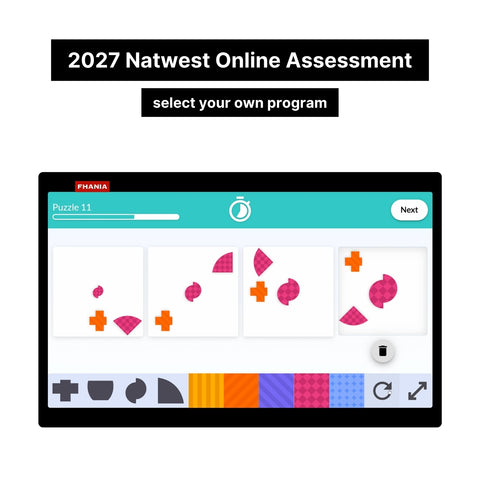
The NatWest inductive reasoning test shows you sequences of shapes or patterns and asks you to pick the next one or spot the odd one out. It appears in the Round-2 ability assessment for the 2027 intake for some programmes. No prior knowledge is tested at all — just your ability to find the hidden rule fast. Candidates who have never seen the format lose most of their time on the first few questions.
What the NatWest Inductive Reasoning Test Is
NatWest uses SHL-style inductive (sometimes called logical or diagrammatic) reasoning within its ability assessment. Each question presents a series of figures that change according to a rule — rotation, shading, position, number of elements — and you select the figure that completes the pattern. The test is timed and adaptive for some programmes, meaning it gets harder as you answer correctly. Because the content is abstract, it feels unfamiliar the first time, which is precisely the point.
What the NatWest Inductive Reasoning Test Assesses
NatWest inductive reasoning questions measure how quickly you learn a new system and apply it — a proxy for how fast you'd pick up new products, processes, or markets on the job. Assessors don't care whether you are "good at puzzles"; they care whether you can spot structure in unfamiliar data without being taught. The scored dimensions are speed of pattern recognition and accuracy under time pressure, both of which improve dramatically with format familiarity.
Inductive Reasoning Test Tips That Actually Work
First, learn the rule vocabulary: rotation, reflection, alternation, addition/subtraction of elements, and shading cycles cover the vast majority of questions. Second, check one attribute at a time — trying to see the whole pattern at once is how people freeze. Third, when stuck, eliminate: most wrong options break the rule in an obvious way. Finally, practice the exact format until recognising rules feels automatic, because the test measures speed, not just insight. Our 2027 NatWest Group Online Assessment and Video Interview Tutorials include the 2027 Round-2 ability assessment with the inductive reasoning formats NatWest uses and worked answers explaining each pattern's rule.
Never Practiced Pattern Questions? You're Donating Marks
Here is the FOMO math: inductive reasoning is the one test where practice transfers almost 1:1 to score. Candidates who have drilled fifty pattern questions see the rules instantly; first-timers burn their timer decoding the format itself. Since the score is benchmarked against other applicants, every mark you leave on the table goes straight to someone who prepared. This is the cheapest score boost in the entire NatWest process — and the easiest to miss if you skip it.
FAQ
Do I need maths for inductive reasoning? No. The test uses abstract shapes, not numbers. It measures pattern recognition, so preparation is about learning rule types.
How do I get faster at pattern questions? Drill one rule type at a time (e.g. only rotation questions) until recognition is instant, then mix types under timed conditions.
What if I can't find the pattern? Eliminate options that clearly break partial rules, make your best guess, and move on. One stuck question should never cost you three.
Is the test the same for all programmes? The inductive reasoning format is broadly consistent, though not every programme includes it. Check your assessment invitation for which ability tests you'll sit.
Preparing for NatWest's inductive reasoning test? Our 2027 NatWest Group Online Assessment and Video Interview Tutorials has the exact questions and answers — $79 one-time, instant download.