Lloyds Inductive Reasoning Test: Pattern Questions Explained
The Lloyds inductive reasoning test shows you sequences of shapes, symbols and diagrams and asks you to find the rule — then pick what comes next. There are no numbers and no words; it's pure logic. Candidates who rely on gut feeling treat it like a lottery, but every pattern follows a learnable rule, and that's what this guide covers.
What the Lloyds inductive reasoning test looks like
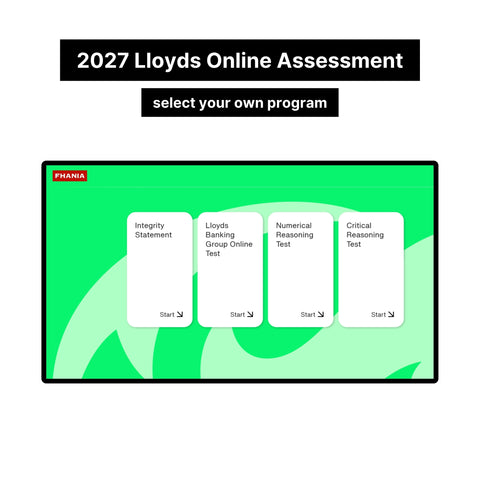
Within the Cappfinity assessment, the Lloyds inductive reasoning test presents series of abstract figures: shapes that rotate, flip, grow, shrink, change colour, or move around a grid. Your job is to spot the transformation rule across the sequence and select the figure that continues it. Some questions show a matrix with one cell missing. The patterns layer multiple rules at once — for example, the shape rotates 90 degrees each step while the dot count increases by one — and the difficulty ramps up as the section progresses.
The rules behind Lloyds inductive reasoning patterns
Every Lloyds inductive reasoning test question is built from a small set of mechanics: rotation, reflection, addition/subtraction of elements, alternation between two states, and positional movement. The trick is working systematically instead of staring. Check one attribute at a time — shape first, then size, then shading, then position — and eliminate answer options that break the rule you've found. Most candidates fail because they try to "see" the whole pattern at once; the methodical ones treat it like a checklist and finish faster.
How to prepare for the Lloyds inductive reasoning test
You can't study content for this section — there are no facts to memorise — but you can absolutely train the skill. Drill real Lloyds-style pattern questions under timed conditions until the common rule types are instantly recognisable. Time yourself ruthlessly: these questions are designed so that hesitation, not difficulty, defeats you. Our 2027 Lloyds Bank Online Assessment & Job Insight Assessment Tutorials contain the exact questions and answers from the Lloyds inductive reasoning test, so you're training on real patterns, not generic puzzles.
Guessing by feel is gambling — and the house always wins
Here's the uncomfortable truth: candidates who "go with their gut" on the Lloyds inductive reasoning test are just rolling dice with their application. The test is engineered so that wrong answers look plausible to anyone who hasn't identified the actual rule. But flip that around — once you've drilled the rule types, this section becomes the most predictable part of the whole assessment. The candidates who pass aren't smarter; they're just the ones who stopped guessing and learned the system.
Lloyds inductive reasoning test FAQs
Is the Lloyds inductive reasoning test an IQ test? No. It measures logical problem-solving, and performance improves dramatically with practice. "Natural ability" is mostly a myth here — familiarity with rule types is the real advantage.
How much time do I get per question? Each question has a tight individual timer within the overall assessment. If a pattern doesn't reveal itself within 30–40 seconds, eliminate obvious wrong answers, guess, and move on.
Do I need maths for this section? No calculations at all. It's visual logic — shapes, positions, and transformations. Many candidates find it a relief after the numerical section.
Can I practice effectively without real questions? Generic puzzles teach the basics, but Lloyds's patterns have their own flavour. Practicing the exact question style is what converts technique into speed on test day.
Preparing for Lloyds's inductive reasoning test? Our 2027 Lloyds Bank Online Assessment & Job Insight Assessment Tutorials has the exact questions and answers — $79 one-time, instant download.