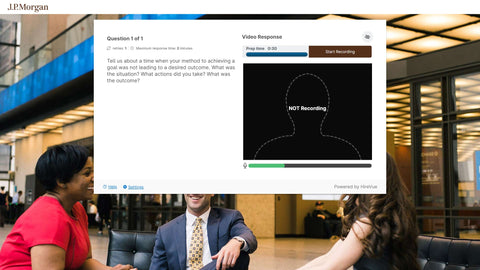
The 2027 Commercial and Investment Bank Markets Summer Analyst Program at J.P. Morgan in Hong Kong opens with a recorded HireVue before a human joins the process, and it cuts a lot of people early. The ones who clear it usually practiced the real questions rather than improvising into a webcam. This is a one question interview, Question 1 of 1, one retry, roughly 30 seconds of prep and 2 minutes to answer. There is no second question to recover on. It is behavioral, and it is really asking whether you can see your own approach failing and change it in time.
Here is the exact wording:
Tell us about a time when your method to achieving a goal was not leading to a desired outcome. What was the situation? What actions did you take? What was the outcome?
The prompt seems to lay out the structure for you: situation, actions, outcome. That is exactly where people relax and miss the point. What the desk is grading is whether you recognized the method was not working, said so, and pivoted, not whether you can walk through three headings. In Markets, catching a wrong read early and adjusting is the skill.
Where candidates go wrong
- Choosing a story where the method worked anyway. If the first approach got you there, there was no real pivot and the answer collapses. Pick one where the plan was clearly failing.
- Never admitting it failed. Dressing it up as "it was fine, I just refined it" ducks the whole question. State that the method was not getting the result.
- No actual pivot. "I pushed harder" is the same method with more hours, not a change. Say what you did differently.
- Dropping the outcome. The question asks for it outright. Skip it and the story sounds unfinished.
- Staying vague about the change. "A different approach" says nothing. The value sits in exactly what you noticed and exactly what you switched to.
What a strong answer does
A strong answer starts with a concrete situation and a clear goal: a club project, a case competition, a research target, a sales or fundraising number, something measurable. It names the approach you began with, then the moment you realized it was not working and the signal that told you, flat results, a mentor's blunt feedback, a deadline slipping out of reach. Then it gives the specific change, a different route rather than more effort, and what that change asked of you. It closes with a real outcome, ideally a number, and the point that spotting a failing method early and adapting is the whole skill.
The best answers make the turn quickly. The interviewer is looking for someone who did not sit in denial for weeks before changing course. One situation, the moment it turned, the exact new approach, the result. Keep it near ninety seconds, one honest example, one clear admission that the first way was not working.
Get the ones for your role
With only one question, your example has to land on the first take, so choosing it ahead of time beats improvising on the timer. OfferTutoring keeps the full set of real questions across J.P. Morgan Markets roles if you want your story ready before you record.