GIC Interview Questions 2027: Why Should We Hire You & How to Answer
Answer with a concise value proposition: 2-3 specific strengths evidenced by achievements, mapped explicitly to what the role needs — then close with genuine enthusiasm for the institution. This is a summary pitch, not a life story. This GIC interview question is commonly reported by candidates, usually near the end of the interview.
What GIC Interview Questions Like This Assess
The interviewer is giving you the floor to make your case — they're testing whether you can synthesise your candidacy crisply and whether you understand what the role actually requires. Rambling lists of qualities fail; a tight, evidenced, role-mapped pitch passes. Confidence without arrogance is the tone.
How to Answer GIC Interview Questions: The Strength-Evidence-Mapping Method
Pick 2-3 strengths that the role genuinely needs, and for each give strength → evidence → mapping:
- Analytical rigour: "First, analytical depth — [evidence: e.g., 'my dissertation built a novel dataset on X and earned a first' or 'I built the valuation models for our investment society's competition pitches']. For this role, that translates to investment research I can stand behind."
- Investment judgment: "Second, developing investment judgment — [evidence: e.g., 'running a paper portfolio where I wrote up theses and tracked what proved me wrong']. I think in theses and falsifiability, which fits a long-term investor's process."
- Fit with the institution: "Third, genuine alignment with the long-term model — [evidence: e.g., 'my research has always focused on structural, multi-year questions rather than short-term trades']. I'm not just looking for any investing job; I want this kind of investing."
Sample close: "So: analytical rigour I can evidence, investment judgment I'm actively building, and genuine alignment with long-horizon investing. That's why I believe I'd contribute here — and why I want to."
Keep it to 90 seconds. This is a closing argument, not an opening statement.
Common Mistakes
- Listing adjectives without evidence: "I'm hardworking, passionate, and a team player" — unevidenced claims are noise. Every strength needs proof.
- Strengths that don't map to the role: "I'm great at sales" for a research role shows you don't understand the job. Map every strength to a role requirement.
- Arrogance or desperation: "You'd be lucky to have me" and "I'll do anything" both fail. The tone is confident, specific, and genuinely enthusiastic.
As a closing question in GIC interview questions, this is your last impression — make it structured, evidenced, and warm.
Keep Reading
- bcg market sizing case
- Citi Online Assessment 2027: Numerical, Logical & SJT Guide
- GIC Application Timeline 2027: Key Dates & Process
FAQ
Should I repeat things from earlier in the interview? Yes — deliberately. This is a synthesis: pull together the strongest evidence you've already presented into one coherent case.
How is this different from "tell me about yourself"? That was your story; this is your argument. Story narrates, argument persuades — every point here should connect to why you're the right hire.
Can I ask them a question instead? No — answer the question asked, then ask your questions when invited. Deflecting looks evasive.
What if I genuinely don't know why they should hire me over others? Focus on your specific combination — nobody else has your exact mix of experiences and motivations. Specificity is your differentiator, not superlatives.
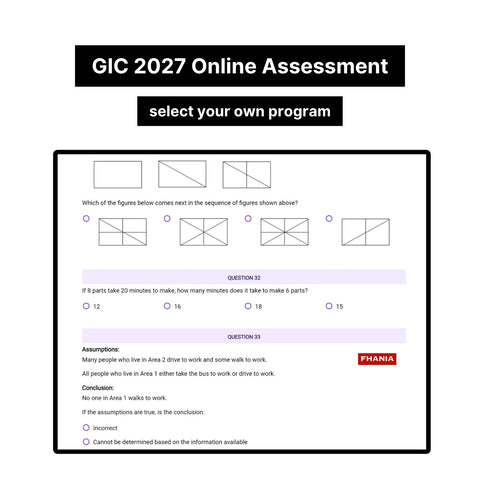
Preparing for GIC's interview? Our 2027 GIC Learning Indicator PI Cognitive Assessment Exact Questions & Answers has practice questions and answers — $79 one-time, instant download.