

GIC Interview Questions 2027: What Kind of Risk Taker Are You & How to Answer
Answer with a calibrated philosophy: you're a calculated risk-taker — comfortable with uncertainty when odds and payoffs justify it, disciplined about sizing and downside — evidenced by a real example. Distinguish risk from recklessness. This GIC interview question is commonly reported by candidates and is philosophically loaded.
What GIC Interview Questions Like This Assess
All investing is risk-taking, and the interviewer needs to know your relationship with uncertainty. They're screening out both extremes — the reckless and the paralysed — and listening for a mature framework: expected-value thinking, downside discipline, and self-knowledge.
How to Answer GIC Interview Questions: Philosophy, Evidence, Discipline
- State your philosophy: "I'm a calculated risk-taker: comfortable acting under uncertainty when expected value justifies it and the downside is understood and sized. I distinguish taking risk from ignoring it."
- Explain the framework: "What's the range of outcomes and rough probabilities? What's the downside if I'm wrong — can I live with it? Is the payoff asymmetric enough? If those check out, I act decisively — waiting for certainty is itself a costly decision."
- Give evidence: "For example, [a real decision: committing to a dissertation topic with no guaranteed data source, having mapped a fallback — or advocating a researched contrarian position in our investment society, sized small given the uncertainty]."
- Connect to investing: "That's how I think about investment risk: the job isn't avoiding uncertainty — it's pricing it, sizing it, and acting when the odds favour you."
Sample line: "I'm a calculated risk-taker — comfortable with uncertainty once I've understood the odds and the downside. The bigger risk in investing is usually inaction. Discipline for me means sizing, not avoiding."
Common Mistakes
- "I'm a big risk-taker": Without the "calculated" framework, this sounds reckless — alarming for a steward of national reserves.
- "I'm risk-averse": For an investment role, this suggests you can't do the job. Even conservative investors take risk; they price it carefully.
- No example: Philosophy without lived evidence is just words. Have one real decision ready.
Risk-philosophy questions are revealing in GIC interview questions — the answer shows whether you understand what investing actually is.
Keep Reading
- bain market sizing rental cars
- GIC Interview Process 2027: Every Stage Explained
- GIC Predictive Index Assessment 2027: Complete Guide
FAQ
Should I mention a financial risk I've taken? Only if responsible and illustrative — a researched decision, not a gamble. Non-financial examples of calculated risk work equally well.
Can I discuss a risk that didn't pay off? Yes — if the decision was sound given what you knew. Good process, bad outcome is the honest reality of risk-taking.
How does this relate to GIC's risk culture? A long-term sovereign investor takes risk deliberately and sizes it institutionally — frame your philosophy as compatible: thoughtful, disciplined, long-horizon.
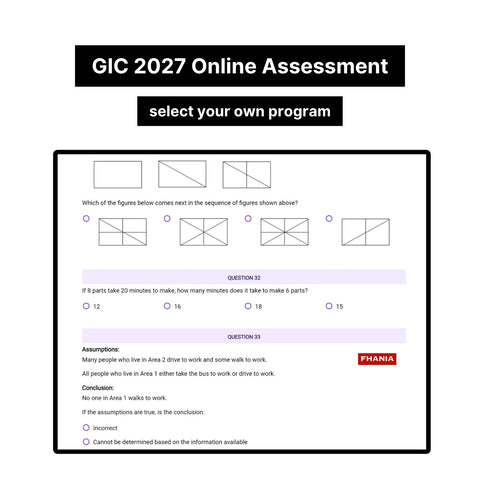
Preparing for GIC's interview? Our 2027 GIC Learning Indicator PI Cognitive Assessment Exact Questions & Answers has practice questions and answers — $79 one-time, instant download.