

EY Situational Judgement Test 2027: How Answers Are Scored
The EY situational judgement test is scored against EY's own values and culture — not generic business logic. You rank or choose responses to workplace scenarios, and your score reflects how closely your answers match what EY considers right. If your answers reflect a different firm's culture, you fail, even when your logic is sound.
What the EY Situational Judgement Test Is
The EY situational judgement test presents realistic workplace scenarios: a colleague asks you to cut corners, a client demands an unrealistic deadline, you spot an error in a senior's work before a deadline. For each, you rank possible responses from most to least effective, or pick the best and worst action.
The scenarios mirror EY's real environment — audit deadlines, client confidentiality, teamwork — not abstract ethics puzzles. Familiarity with professional services is a genuine edge; generic SJT practice from other industries can mislead you.
How the EY Situational Judgement Test Is Scored
There are no objectively correct answers — only answers matching EY's scoring model. EY benchmarks responses against its values (integrity, teamwork, client focus, accountability), and your score reflects the distance between your rankings and EY's model answers. Two candidates can both pick reasonable responses yet score very differently, because one matched EY's priorities and the other did not.
This is what trips up smart candidates. High performers elsewhere import old instincts — protect the client at all costs, shield the team no matter what — and discover EY scores those moves down. The test rewards a specific hierarchy: integrity first, then client responsibility, then team harmony. Getting that order wrong is the most common reason candidates fail this section.
How to Prepare for the EY Situational Judgement Test
Learn EY's values as decision rules, not slogans. For every practice scenario ask: which response protects integrity first, which serves the client responsibly, which supports the team? Drill this hierarchy until reflexive — under time pressure you default to whatever instinct you trained.
Then practise with EY-specific scenarios, not generic question banks. The format matters less than the scoring logic: you need to see how EY phrases scenarios and where its model answers diverge from "common sense." Review every wrong answer by mapping it back to the values hierarchy.
Our 2027 EY Online Assessment and Video Interview Tutorials includes EY-specific situational judgement scenarios from the 2027 cycle with full scoring explanations.
Why Guessing EY's Culture Loses
This test is scored on values alignment: wrong-culture answers mean rejection, no appeal, no second stage. Candidates who assumed "professional is professional everywhere" fail this section across the Big Four, because each firm scores differently. For the 2026 application season, check the official EY careers page for assessment details, then practise with material that teaches EY's actual scoring model. Generic SJT prep is studying the wrong syllabus — real effort, same fail.
FAQ
How is the EY situational judgement test scored? Your rankings are compared against EY's model answers, which encode EY's values. Closer matches score higher.
Is there a published pass mark? No — you are benchmarked per intake, combined with your other sections.
Can I rely on common sense? Partially — but EY's values hierarchy penalises some "common sense" answers, so EY-specific practice is essential.
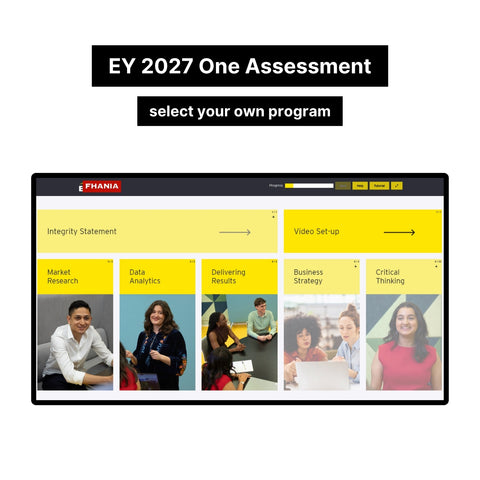
How many scenarios appear? The count varies by intake format; expect a timed set of realistic workplace situations inside the One Assessment.
Preparing for EY's situational judgement test? Our 2027 EY Online Assessment and Video Interview Tutorials has the exact questions and answers — $79 one-time, instant download.