BNP Paribas Case Study Interview 2027: Annual Report Analysis Guide
For the BNP Paribas case study interview "Analyse this annual report and predict the firm's performance next year," work systematically: assess profitability trends, balance sheet strength, and cash generation — then form a forward view from the drivers, not the headlines. Here is how to tackle the bnp paribas case study annual report, step by step.
What the BNP Paribas Case Study Annual Report Assesses
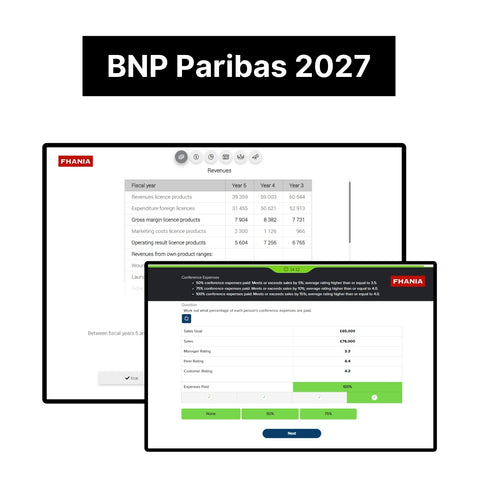
Annual report analysis is commonly reported by candidates in banking interviews because it mirrors real junior work — forming a view from financial statements quickly. The interviewer is testing financial literacy under time pressure: can you find the signal in a dense document, distinguish trends from noise, and reason forward rather than just describing backward? Candidates commonly report that the differentiator is the forward view — anyone can summarise last year; predicting next year requires judgement.
How to Approach the BNP Paribas Case Study Annual Report
Move from diagnosis to prediction in four steps.
- Step 1 — Profitability: Check revenue growth, margin trends, and return on equity over two to three years. Is growth profitable, or bought with margin? One-off items should be stripped out for the underlying picture.
- Step 2 — Balance sheet strength: Assess leverage, liquidity, and asset quality. A profitable company with stretched leverage faces different risks than a cash-rich one — the forward view depends on this.
- Step 3 — Cash generation: Compare operating cash flow to reported profit. Persistent gaps — profits without cash — are a red flag worth naming explicitly.
- Step 4 — Predict with drivers: Build the forward view from the drivers: which trends continue, which revert, and what could break the pattern. State a base case ("assuming margins stabilise, growth of X implies..."), then name the two biggest risks to that view.
Example line: "I would start with the three-year profitability and margin trend to find the underlying trajectory, check leverage and cash conversion for fragility, then predict next year from the drivers — for example, whether margin pressure looks structural or cyclical — with the key risks stated."
Common Mistakes With the BNP Paribas Case Study Annual Report
- Describing instead of analysing. "Revenue grew 8%" is description; "revenue grew 8% but margins compressed 200bps, suggesting growth was bought on price" is analysis. The interviewer wants the second.
- Ignoring cash. Candidates commonly report that accrual-profit-versus-cash is a favourite probe — always check whether profits turn into cash.
- Predicting without drivers. "I think next year will be good" is a guess. Tie every forward statement to a driver you identified in the analysis.
Annual report cases reward the habit of reading financials like a detective: every number is a clue about the business underneath. Practice on real reports until the profitability-leverage-cash flow scan takes minutes, not hours.
Keep Reading
- jp morgan how do you stay on top of markets
- BNP Paribas HireVue Questions 2027: Full List & Model Answers
- BNP Paribas Numerical Reasoning Test: Format, Questions & How to Pass
FAQ
How should I handle the time pressure? Triage: income statement trends first, then balance sheet red flags, then cash flow. A structured fifteen-minute scan beats an exhaustive hour.
What ratios matter most? Revenue growth, operating margin trend, ROE, leverage (debt to equity or EBITDA), and cash conversion. Five ratios tell most of the story.
Should I read the management commentary? Yes, but sceptically — it is the company's own narrative. Use it for context on strategy, then verify against the numbers.
Preparing for BNP Paribas's interview? Our 2027 BNP Paribas Online Test and Pymetrics Test Tutorials has practice questions and answers — $79 one-time, instant download.