BCG Market Sizing Questions: Framework & Worked Examples
BCG market sizing questions ask you to estimate something unknowable — "How many pizzas are sold in London each year?" — using structured logic and clean math. They appear in candidate-led cases as standalone drills and inside larger cases, and a collapsed sizing is the fastest way to convince an interviewer your math can't be trusted.
What BCG Market Sizing Questions Are
A BCG market sizing question gives you a broad estimation problem with no data provided. The classic structure: segment the population, estimate penetration and frequency, multiply through, then sanity-check the result. Example: "Estimate the annual revenue of the UK coffee shop market." You'd segment by population, estimate coffee drinkers, visits per week, average spend — and compute.
BCG uses sizings to test structured thinking under uncertainty, not to get a "right" number. The interviewer watches your approach: sensible MECE segments, stated assumptions, clean arithmetic while talking.
The BCG Market Sizing Framework
Use this repeatable framework for any BCG market sizing question:
- Clarify and segment. Restate the question, then break the population into relevant segments (by age, income, geography — whatever fits).
- Build the equation. Population × penetration × frequency × price. State each assumption before using it.
- Compute in round numbers. Simplify aggressively — 67 million becomes 70 million. Precision theater wastes time.
- Sanity-check. Compare your answer against something known. If your UK coffee market is bigger than the entire UK grocery market, revisit your assumptions.
Skipping the sanity check is the most common failure — candidates who can't catch their own order-of-magnitude errors fail the judgment test.
How to Prepare for BCG Market Sizing Questions
Drill sizings daily until the framework is automatic. Pick one estimation question per day, solve it out loud with a timer (aim for under 5 minutes), and always finish with a sanity check.
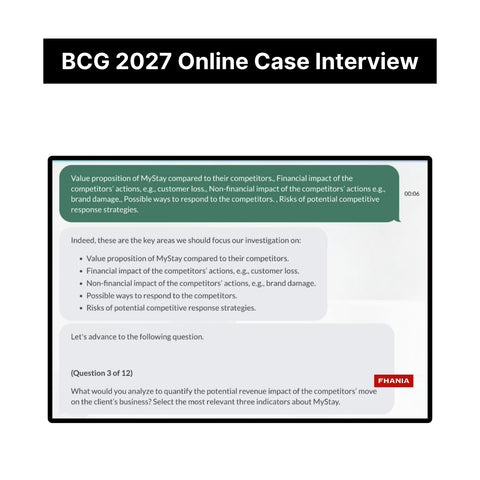
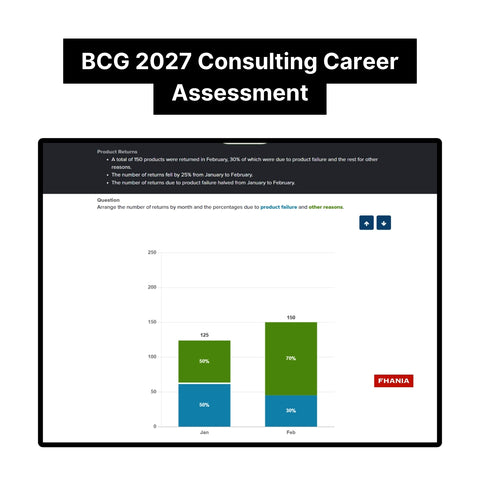
Then practice sizings inside real cases, where they actually appear. Our BCG prep tutorial includes nine real BCG offline interview cases with full answers — many with embedded market sizing and quantitative segments — plus the Quantitative Reasoning Test with real questions and answers, the HireQuo Online Case, and the Consulting Career Assessment. Work the real cases to see how BCG weaves sizing into live case flow, then drill the standalone framework until your math is fast and your assumptions are defensible.
A blown sizing poisons the whole case. Once an interviewer decides your numbers can't be trusted, every subsequent analysis gets discounted — and in a candidate-led BCG case, there's no interviewer to rescue you. The 2027 intake candidates who pass are the ones whose market sizing is boringly reliable: clean segments, stated assumptions, fast math, and a sanity check every single time.
FAQ
How long should a BCG market sizing take? Aim for 4-6 minutes including the sanity check. Longer means your structure is too complex.
Do I need exact population figures memorized? No — reasonable round-number estimates are expected; just state your assumptions.
What if my final number is wrong? The number being "wrong" doesn't matter; the logic and math being sound does. Always sanity-check and adjust transparently.
Do market sizings appear in the online case too? Estimation-style quantitative questions can appear in the Casey chatbot and Quantitative Reasoning Test — the same structured approach applies.
Preparing for BCG's Market Sizing Questions? Our 2027 BCG Consulting Career Assessment, Online Case and Quantitative Reasoning Test Tutorials has the exact questions and answers — $79 one-time, instant download.