Bank of England Situational Judgement Test: Format & How to Pass
The Bank of England situational judgement test is an online screening stage of the 2027 graduate intake. You face 45 work scenarios and must rank or choose responses that reflect the Bank's values: integrity, collegiality and inclusion. You pass it by thinking like a central banker, not by guessing — and that is a learnable skill.
What Is the Bank of England Situational Judgement Test?
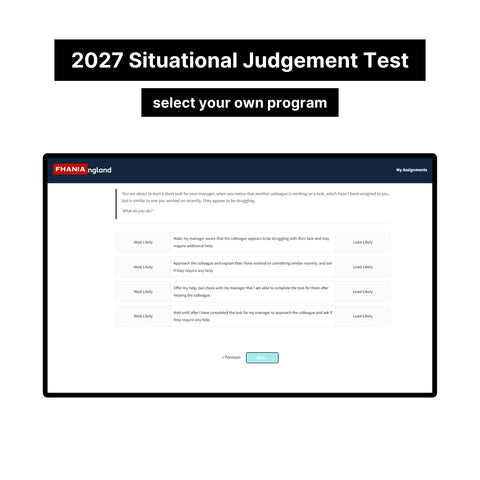
The Bank of England situational judgement test is typically the first timed assessment after your online application. It presents realistic workplace scenarios — a deadline clash, a colleague cutting corners, a stakeholder who disagrees with you — and asks you to select the most and least effective responses, or rank a set of actions from best to worst. There are around 45 questions, delivered online, and you cannot pause once you start. It is designed to screen for judgement and values fit before the video interview stage.
What the Bank of England SJT Actually Tests
Every scenario maps to one of the Bank's core competencies. The recurring themes are:
- Ethical dilemmas — doing the right thing when nobody is watching
- Prioritisation — juggling competing deadlines and stakeholders
- Teamwork — supporting colleagues rather than chasing personal credit
- Stakeholder communication — adapting your message to different audiences
- Coping with stress and uncertainty — staying composed when plans change
- Conflict handling — resolving disagreements professionally
- Initiative and creativity — improving processes without being asked
The questions are not looking for textbook answers. They test whether your instincts match how the Bank operates: careful, collaborative, and accountable.
How to Prepare for the Bank of England Situational Judgement Test
Generic SJT practice from other employers will not cut it — the Bank of England's values and marking scheme are its own. The most effective method is to practise with real Bank of England-style questions and review detailed explanations for every answer, so you learn the reasoning pattern rather than memorising responses. Do timed runs of the full 45-question set, then go back and study every question you got wrong. Our 2027 Bank of England Situational Judgement Test and Video Interview and Answers includes the exact question types and model answers, so you walk in already knowing how the Bank expects you to respond.
Do not wait until assessment season to start. Candidates who begin practising early consistently report the SJT feels straightforward — because they have already seen every scenario type before.
Frequently Asked Questions
How long is the Bank of England situational judgement test? The test has roughly 45 scenario questions and is completed online in one sitting. Set aside uninterrupted time and a stable connection.
Is the Bank of England SJT hard to pass? It is hard if you wing it. The traps are subtle — two answers can both look reasonable, but only one reflects the Bank's values. Targeted practice makes it very beatable.
Can I retake the Bank of England SJT? Generally you get one attempt per intake. A failed attempt means waiting for the next application cycle, so prepare properly the first time.
What comes after the Bank of England SJT? Successful candidates progress to the video interview, then the assessment centre. Check the Bank's official careers page for the 2027 intake timeline.
Preparing for Bank of England's Situational judgement test? Our 2027 Bank of England Situational Judgement Test and Video Interview and Answers(https://offertutoring.com/products/bank-of-england-prep-tutorials) has the exact questions and answers — $79 one-time, instant download.