Akuna Capital Probability Test: Expected Value Questions Explained
The Akuna Capital probability test is built almost entirely around expected value — dice games, card draws, and betting scenarios where you must decide if a gamble is worth taking. If you cannot compute expected value quickly and correctly, this round eliminates you. This guide explains the question style and the fastest way to master it.
What the Akuna Capital Probability Test Is
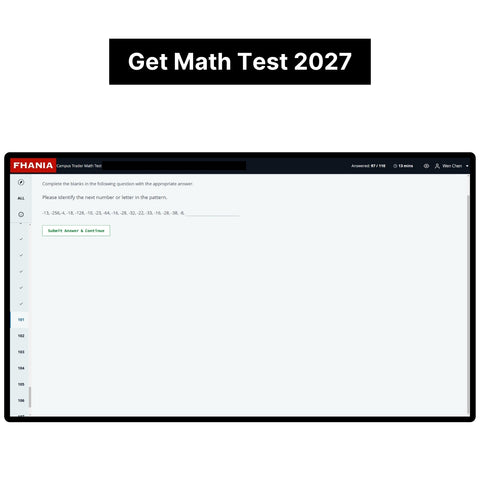
After the math screen, trader and quant candidates face a probability assessment focused on practical decision-making under uncertainty. For the 2027 intake, the format centers on expected value (EV) questions: you are given a game with random outcomes and payoffs, and must compute whether the bet has positive or negative expectation — often with a twist, like an entry fee, repeated rounds, or conditional events. Questions are timed, and the difficulty ramps from single-die basics to multi-stage games.
What the Akuna Capital Probability Test Assesses
Market making is applied probability, so the Akuna Capital probability test measures whether you think in expected values the way a trader does. It assesses three things: fluency with EV computation (probability × payoff, summed across outcomes), judgment about risk (would you take this bet, and at what price would you be indifferent?), and speed — you need the EV of a two-dice game in your head in seconds, not minutes. The classic trap is the "fair price" question: candidates compute the EV but forget to subtract the cost of playing. Akuna notices.
How to Prepare for the Akuna Capital Probability Test
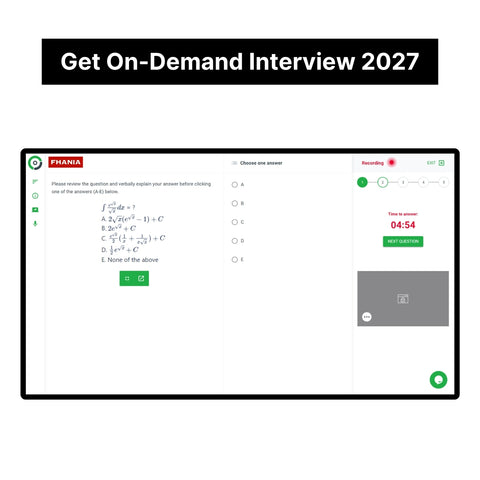
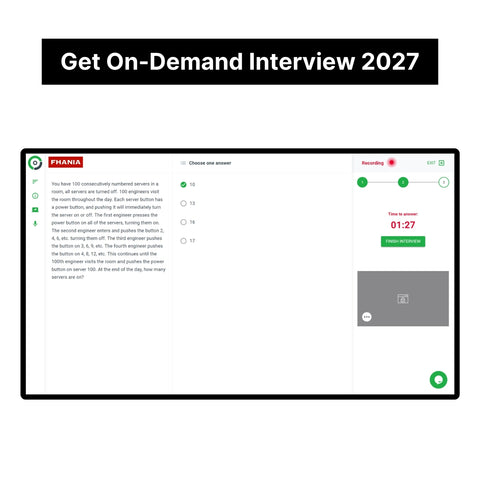
First, drill the core toolkit until it is automatic: expected value, conditional probability, linearity of expectation, and basic combinatorics. Second, practice the canonical question types — dice sums, card draws without replacement, coin-flip streaks, and "what price makes this game fair?" variants. Third, and most importantly, study real Akuna questions, because the firm recycles the same game structures with different numbers. Our 2027 Akuna Capital Coding Challenge Math Test Probability Test On-demand Interview Exact Questions & Answers contains the exact expected-value questions from recent Akuna rounds with full worked solutions, so you recognize the game the moment it appears and compute instead of thinking.
FAQs
What topics appear on the Akuna Capital probability test? Expected value dominates, plus conditional probability, combinatorics, and fair-price/betting questions.
How is the Akuna Capital probability test different from a stats exam? It is timed and decision-oriented — less proof, more "should you take this bet?" under pressure.
Which roles take the Akuna Capital probability test? Junior trader and quantitative researcher candidates in the 2027 intake.
Do I need advanced probability theory for the Akuna Capital probability test? No — speed with fundamentals beats deep theory. Linearity of expectation solves most questions.
EV Is the Whole Game
Almost every question on the Akuna Capital probability test reduces to expected value. If you cannot spot the EV structure instantly, you will burn your time on arithmetic while prepared candidates finish early. The candidates who pass are not smarter — they have seen the games before. See them before your test, not during it.
Preparing for Akuna Capital's probability test? Our 2027 Akuna Capital Coding Challenge Math Test Probability Test On-demand Interview Exact Questions & Answers has the exact questions and answers — $79 one-time, instant download.